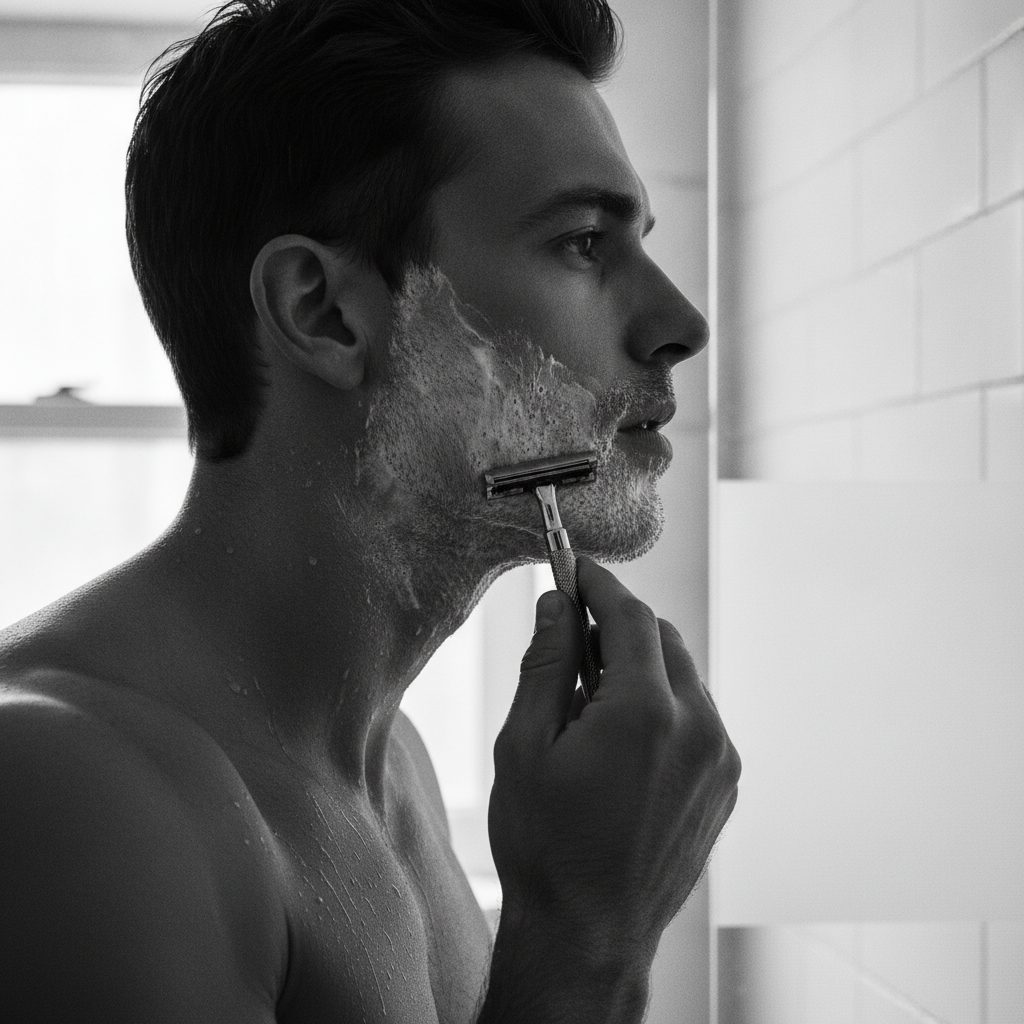
A straight razor is a single folding blade that must be maintained, stropped before each shave, and periodically honed on a whetstone or sent to a professional honer. In exchange for this maintenance obligation, it provides a shave that most experienced practitioners describe as superior to any other method: smoother, closer, and significantly less irritating than any multi-blade cartridge system. It also represents a permanent blade investment — a quality straight razor, properly maintained, will shave for decades.
The learning curve is real and should not be minimized. Most men take four to eight weeks of regular practice before they achieve shave quality comparable to their previous method. Cuts and nicks during this period are normal. Patience and deliberate practice during the learning phase determine the outcome, not innate ability.
Choosing Your First Straight Razor
Blade width is the first specification to understand. Straight razors are measured in eighths of an inch. The most common sizes are 5/8", 6/8", and 7/8". For beginners, a 5/8" blade is the standard recommendation — it is wide enough to shave efficiently but narrow enough to navigate the curves of the face (particularly around the chin and under the nose) without the additional technique demands of a wider blade.
Hollow grind refers to the curvature of the blade's face. Full hollow grind blades are lighter and more flexible, making them easier to strop correctly but slightly more sensitive to angle variation during shaving. Extra hollow or wedge grinds are heavier and more stable, preferred by experienced shavers. For beginners, a full or half hollow grind is recommended.
New vs Vintage Blades
Vintage straight razors from manufacturers like Wade & Butcher, W&B, and Friodur are often recommended by enthusiasts for their steel quality. However, a vintage razor purchased without a professional hone is never shave-ready — the edge will have degraded from storage and must be professionally set before first use, adding cost and delay. For beginners, a new razor from a reputable manufacturer that ships hone-ready (shave-ready) is strongly recommended to eliminate this variable.
The Strop: Daily Maintenance
A leather strop is used before every shave to realign the blade's edge. Straight razor shaving does not wear down the edge as quickly as people assume — the primary mechanism of degradation is edge rolling, where the microscopic wire edge bends slightly from use. Stropping realigns this edge by drawing the blade spine-first along smooth leather, which straightens the edge without removing steel.
The standard strop is a two-sided hanging strop: one side canvas or linen (for rough conditioning), one side leather (for final alignment). Before each shave, complete fifteen to twenty passes on the canvas side followed by fifteen to twenty passes on the leather side. The motion is always spine-leading — the sharp edge faces backward relative to the direction of travel across the strop.
Incorrect stropping technique — particularly applying too much pressure or dragging the edge rather than the spine — is the fastest way to destroy an edge. Learning correct stropping on a practice razor or a dowel rod before applying to a real blade is recommended by many instructors.
The Shaving Technique
The correct angle for a straight razor is approximately 20–30 degrees from the skin. This is significantly shallower than most beginners instinctively use. A useful initial guide is to lay the spine of the razor flat against the cheek, which establishes approximately 20 degrees, then lift slightly. Finding and maintaining this angle is the central technical challenge of straight razor shaving.
Pressure should be essentially zero — the weight of the razor itself provides sufficient force when the edge is sharp and the angle correct. Applying downward pressure with a sharp straight razor is the primary cause of significant cuts in beginners. Think of guiding the razor rather than pressing it.
For the first several weeks, shave only with the grain — down the cheeks and down the neck. Do not attempt against-the-grain passes until the with-grain pass is comfortable and producing acceptable results. Against-the-grain passes on the neck with a straight razor require a level of technique that takes time to develop.
Beginner Equipment Checklist
| ITEM | SPECIFICATION | APPROX COST | NOTES |
|---|---|---|---|
| Straight Razor | 5/8", full hollow, shave-ready | $80–$150 | Buy shave-ready, not vintage unset |
| Hanging Strop | 2" wide, canvas + leather | $30–$60 | Practice stropping before shaving |
| Shaving Brush | Synthetic or badger | $25–$50 | Any quality brush works |
| Shaving Soap | Glycerin or tallow base | $10–$22 | Dense lather is more important here than with DE |
| Alum Block | Potassium alum, 75g+ | $10–$14 | Essential during learning phase |
When to Have Your Razor Honed
Stropping maintains the edge; it does not restore it. A straight razor will eventually lose its sharpness through use and will need to be honed on a whetstone to restore the edge. For most users shaving three to five times per week, this happens every four to six months. Signs that honing is needed include increased tugging, reduced cutting efficiency, or a rough post-shave feel despite correct stropping.
Professional honing services are available from wet-shaving specialty suppliers and typically cost $15–$30. Learning to hone yourself is possible and rewarding but requires additional investment in whetstones ($50–$200 depending on quality) and time to develop consistent technique.
For the complete shaving setup to pair with a straight razor, see our guide to best shaving soaps for wet shaving and our pre-shave oil recommendations.