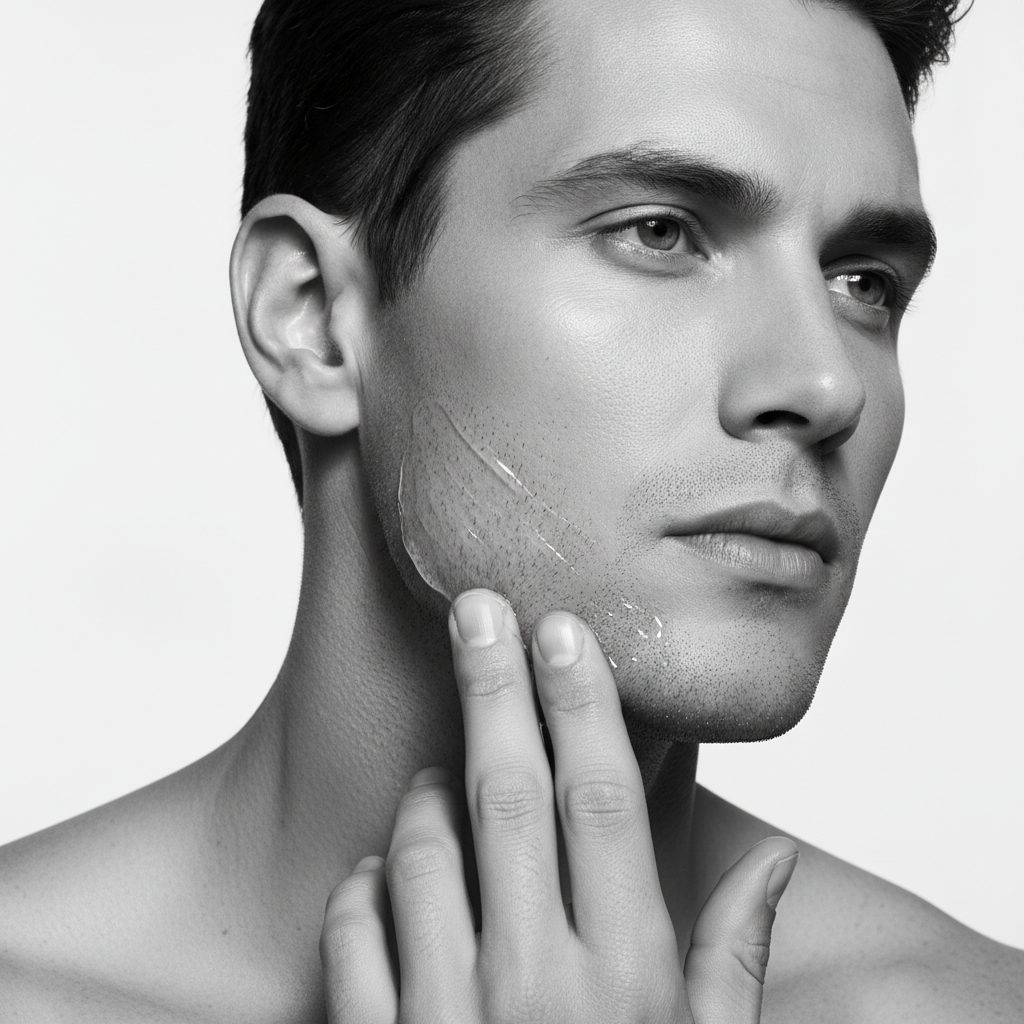
Men's skin ages differently — and faster in some respects than you might expect. Starting around age 25, your body produces roughly 1% less collagen per year. That's a slow bleed, invisible for the first decade, then suddenly very legible in your late thirties. Male skin is structurally different from female skin: it runs about 25% thicker due to higher androgen levels, which provides some early resilience. But that same thickness means the loss, when it accelerates, hits harder and more visibly. Crow's feet deepen. Nasolabial folds set in. The jaw softens.
There's another variable most men overlook: shaving. A daily wet shave is essentially a form of micro-exfoliation — the blade strips away a superficial layer of dead skin cells with every pass. Done right, this promotes mild cellular turnover. Done without a proper moisture barrier restored afterward, it compounds transepidermal water loss (TEWL) and leaves skin reactive, sensitized, and more vulnerable to environmental oxidative stress. The anti-aging cream you apply post-shave isn't vanity. It's maintenance protocol for a skin barrier under daily mechanical stress.
This guide cuts through the marketing language. Below you'll find the five best anti-aging creams for men in 2026, chosen on ingredient efficacy, texture suitability for male skin, and honest price-to-performance ratio. Before the picks, the science you need to understand what you're buying.
The Active Ingredients That Actually Work
The anti-aging skincare market generates billions in revenue annually, but the evidence base for most marketed ingredients is thin. A handful of actives, however, have robust clinical support. These are the ones worth spending money on.
Retinol (Vitamin A). The most thoroughly studied topical anti-aging compound in dermatology. Retinol is a retinoid — it binds to retinoic acid receptors in skin cells and directly upregulates genes responsible for collagen synthesis while simultaneously accelerating cellular turnover. The result is a dual mechanism: new collagen is produced while surface layers of skin refresh faster, reducing the appearance of fine lines and improving texture. The trade-off is initial irritation; retinol degrades the skin barrier during the adaptation phase. Start with a low concentration (0.025–0.05%) two nights per week and build from there. Use only at night — retinol is photodegradable and sun exposure while using it increases UV sensitivity.
Peptides. Peptides are short chains of amino acids that function as signalling molecules in skin tissue. Tripeptide-1 (glycine-histidine-lysine), for instance, stimulates fibroblast activity, directly promoting collagen and elastin production. Palmitoyl tripeptide-1 and palmitoyl tetrapeptide-7, found in many premium formulas, work synergistically — one suppresses inflammation, the other triggers matrix repair. Unlike retinol, peptides carry minimal irritation risk, making them suitable for daily use on sensitive or recently shaved skin.
Hyaluronic Acid (HA). A glycosaminoglycan that occurs naturally in skin's extracellular matrix. HA can bind up to 1,000 times its molecular weight in water, making it the most efficient humectant available to formulators. In topical application, it reduces transepidermal water loss (TEWL) — the passive evaporation of moisture through the stratum corneum — which is a key driver of fine lines and dullness. Look for formulas that include both high- and low-molecular-weight HA: high-molecular-weight HA forms a barrier on the skin's surface while low-molecular-weight HA penetrates deeper layers.
Niacinamide (Vitamin B3). A multi-functional active with strong clinical backing. Niacinamide inhibits the transfer of melanosomes (pigment granules) between melanocytes and keratinocytes, reducing hyperpigmentation and uneven tone. It simultaneously strengthens the skin's lipid barrier by stimulating ceramide synthesis, reduces sebum production in oily zones, and has documented mild anti-inflammatory effects. At concentrations of 4–5%, it measurably improves the appearance of enlarged pores — particularly relevant for men with coarser skin texture.
SPF. The most important anti-aging ingredient is not sold as an anti-aging ingredient. UV radiation is responsible for an estimated 80–90% of visible skin aging — a process dermatologists call photoaging. UVA rays (which penetrate cloud cover and glass) degrade collagen and elastin fibers directly, generate reactive oxygen species, and mutate DNA in skin cells. Broad-spectrum SPF 30 applied daily, every day, prevents more future damage than any retinol or peptide product can repair. It is non-negotiable. If your moisturizer doesn't include SPF, you need a separate sunscreen step.
What Men Should Avoid in Anti-Aging Products
The ingredient list on a moisturizer can run forty entries long. Most are inert. A few are actively counterproductive for anti-aging goals.
- Alcohol denat (denatured alcohol). Used as a solvent and to give products a quick-dry, non-greasy finish — which is why it's prevalent in men's grooming. The problem: alcohol denat disrupts the skin's lipid bilayer, accelerating TEWL and impairing the barrier function you're trying to reinforce. On recently shaved skin, it's particularly harsh. Avoid any formula that lists alcohol denat in the top five ingredients.
- Synthetic fragrance. Listed as "parfum" or "fragrance" on INCI labels. Fragrance compounds are among the most common causes of contact dermatitis in skincare products. Fragranced formulas on post-shave skin — already sensitized by mechanical exfoliation — can trigger persistent low-grade inflammation, which counteracts collagen-protective goals. Choose fragrance-free or naturally scented-with-disclosed-ingredients formulas wherever possible.
- Comedogenic oils on acne-prone or oily skin. Not all oils are created equal. Coconut oil, cocoa butter, and isopropyl myristate score high on the comedogenicity scale — they occlude pores and contribute to breakouts. For oily or combination skin types, check that any oil component in your moisturizer has a low comedogenic rating. Squalane, rosehip, and marula oil are generally well-tolerated.
Texture Matters for Shaved Skin
Ingredient chemistry is only half the equation. The base formulation — the texture — determines how an active actually interacts with your skin type and whether it's viable as a daily post-shave protocol.
Creams are emulsions with a higher ratio of oils to water. They provide richer occlusion, sealing in moisture and creating a sustained barrier. Ideal for dry, dehydrated, or mature skin types. The trade-off is a heavier skin feel and potential for pilling under SPF or makeup. Post-shave, creams work well if your skin tends to feel tight or flaky after shaving.
Gels are water-based, typically with minimal oil content. They absorb quickly, leave no residue, and feel weightless on skin. The right choice for oily, acne-prone, or combination skin. The limitation: without adequate occlusives in the formula, gels may not retain moisture as effectively — TEWL remains higher than with cream formulations on very dry skin.
Gel-creams occupy the middle ground: lightweight enough to not overwhelm oily zones but with sufficient emollient content to address dehydration. For men with normal-to-combination skin who shave daily, gel-creams are typically the most versatile format.
A useful test: if your skin feels tight within 30 minutes of applying your current moisturizer, the formulation is insufficient. If it looks shiny and congested after an hour, the formula is too heavy. Match texture to skin type first, then optimize for actives.
The 5 Best Anti-Aging Creams for Men in 2026
#1 — Kiehl's Age Defender Moisturizer — Best Overall
Kiehl's Age Defender is built around a caffeine and soy protein complex that targets two distinct aging vectors simultaneously. Caffeine is a vasoconstrictor and antioxidant — it reduces puffiness by constricting subcutaneous vessels and neutralizes free radical damage triggered by UV and pollution. The soy protein component (hydrolysed soy protein) provides amino acids that support the skin's structural matrix, contributing to the firmness improvement the formula markets aggressively. Independent testing shows meaningful improvement in skin firmness and pore appearance within eight weeks of consistent use. The texture is a medium-weight cream — rich enough for dry post-shave skin, not so heavy it congests oily zones.
#2 — Jack Black Double-Duty Face Moisturizer SPF 20 — Best With Sun Protection
Jack Black's Double-Duty earns its place as the SPF pick on merit: it's one of the few men's moisturizers that combines meaningful anti-aging actives with a legitimate broad-spectrum sunscreen in a single, wearable formula. Blue algae extract (Laminaria saccharina) provides a concentrated antioxidant payload, protecting against oxidative stress from UV and environmental pollution. The formula's antioxidant blend — including vitamin E and green tea polyphenols — works synergistically with the SPF 20 mineral and chemical filter system. SPF 20 filters approximately 94% of UVB rays, which while lower than SPF 30, is significantly better than zero — and critically, it makes this a formula men will actually apply daily without resisting the texture.
#3 — Brickell Men's Revitalizing Anti-Aging Cream — Best Natural Formula
Brickell occupies a specific niche: men who want clinical anti-aging performance without synthetic retinol. Their Revitalizing Cream uses bakuchiol as the retinol alternative — a plant-derived compound extracted from the seeds of Psoralea corylifolia. A 2019 comparative study in the British Journal of Dermatology found bakuchiol to be comparable to retinol in reducing fine lines and improving skin pigmentation over 12 weeks, with significantly less irritation. Paired with high-molecular-weight hyaluronic acid and a peptide blend, the formula addresses cellular turnover, hydration, and structural repair without the adaptation phase or photosensitivity risk that retinol carries. The cream texture is rich but absorbs cleanly — well-suited to dry or mature skin types.
#4 — Bulldog Original Moisturizer — Best Budget Option
At approximately $12, Bulldog's Original Moisturizer shouldn't deliver this well — but it does. The formula is fragrance-free (a rare virtue at this price point) and built around three botanicals with genuinely useful properties: aloe vera for soothing and light hydration, green tea extract for antioxidant protection against free radical damage, and camelina oil — a cold-pressed seed oil with a high omega-3 content and a low comedogenic rating. Camelina oil is particularly notable: it's rich in linolenic acid, which supports the skin's lipid barrier without clogging pores. Bulldog won't correct deep lines the way retinol or peptides will, but as a daily driver for men building their first anti-aging routine, or as a travel formula, it punches well above its price.
#5 — Clinique for Men Maximum Hydrator — Best for Oily Skin
Clinique's Maximum Hydrator deploys a water-activated gel technology — on application, micro-encapsulated water molecules burst and release hydration as the formula warms to skin temperature. The base is entirely oil-free, which makes it an unusual anti-aging option: most formulas targeting mature skin lean on emollient oils for occlusion, which oily or combination skin types tolerate poorly. The hyaluronic acid system here handles humectancy without the greasy residue, and the gel-cream texture absorbs in seconds, leaving a matte finish that works under SPF or alone. For men whose skin trends oily — particularly in the T-zone — this is the formula that won't congest pores while still addressing dehydration and early fine lines.
Side-by-Side Comparison
| PRODUCT | KEY ACTIVE | TEXTURE | SPF | PRICE |
|---|---|---|---|---|
| Kiehl's Age Defender | Caffeine + Soy Protein | Medium Cream | None | ~$60 |
| Jack Black Double-Duty | Blue Algae + Antioxidants | Lightweight Lotion | SPF 20 | ~$38 |
| Brickell Revitalizing | Bakuchiol + Hyaluronic Acid | Rich Cream | None | ~$55 |
| Bulldog Original | Green Tea + Camelina Oil | Light Lotion | None | ~$12 |
| Clinique Maximum Hydrator | Hyaluronic Acid (water-activated) | Oil-Free Gel-Cream | None | ~$35 |
Final Protocol Notes
Anti-aging skincare for men operates on a simple hierarchy. Daily SPF prevents the majority of future photoaging — it is the foundational layer. A retinol or bakuchiol product used consistently at night addresses cellular turnover and existing collagen deficit. Hyaluronic acid and peptides fill in the gaps, managing hydration and signalling ongoing repair. The five formulas above cover each position in that hierarchy at different price points and for different skin types.
If you're building from scratch: start with Jack Black Double-Duty for daytime SPF coverage, and introduce Brickell's Revitalizing Cream three nights per week as your retinol-alternative night treatment. From there, the protocol scales with budget and skin complexity.
For deeper guidance on building a complete evidence-based skincare system around these products, see the full Blade Concept Skin Protocols Hub. If you're ready to add vitamin C to your antioxidant stack — one of the most synergistic pairings with both SPF and retinol — read our dedicated breakdown: Best Vitamin C Serum for Men 2026.