BLADE CONCEPT
THE SCIENCE ARCHIVE

THE SCIENCE
OF GROOMING

Evidence-based analysis of blade metallurgy, skin biology, and fragrance chemistry. The engineering behind the ritual.

MODULE 01 / METALLURGY

BLADE METALLURGY

The Rockwell C scale (HRC) measures hardness by measuring indentation depth under a 150 kg load. Stainless steel blades typically fall at 55–58 HRC — hard enough to hold an edge, soft enough to resist brittle fracture under lateral force. Titanium-coated blades reach an effective surface hardness equivalent to 800 Vickers (HV), substantially extending edge retention.

The cutting edge geometry is critical: premium double-edge blades are ground to an inclusive angle of 10–15 degrees per side. Foil shaver blades operate at a different geometry — their cutting edges are perpendicular to the direction of motion, relying on the foil holes to align hair for shearing rather than a raking cut.

STAINLESS STEEL
55–58 HRC
TITANIUM COAT
~800 HV
EDGE ANGLE
10–15°/side
DLC COATING
64 HRC equiv.
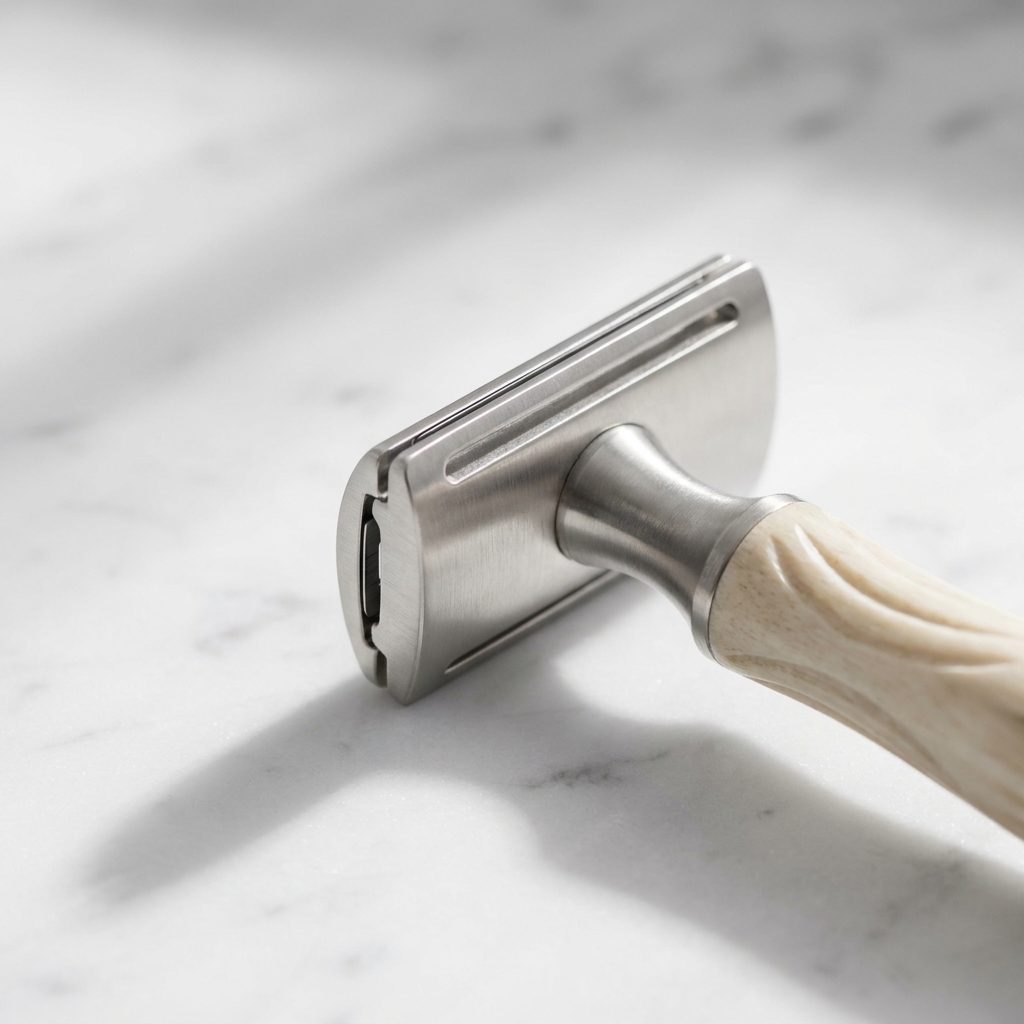
Safety razor head
Facial toner mist
MODULE 02 / DERMATOLOGY

SKIN BIOLOGY

The stratum corneum is the outermost layer of the epidermis — a 15-cell-deep structure of dead keratinocytes embedded in a lipid matrix. Every shave mechanically removes a portion of this barrier. In male skin, this barrier is substantially thicker (male dermis is approximately 25% thicker overall) but more frequently disrupted due to daily shaving practice.

Male sebaceous glands produce 4× more sebum per unit area than female equivalents, driven by androgenic hormones. This elevated sebum production provides natural occlusion (barrier protection) but creates a challenging environment for skincare formulations — products must penetrate a sebum-rich surface to reach the viable epidermis.

Trans-epidermal water loss (TEWL) increases in the hours after shaving, as the reduced stratum corneum provides less barrier resistance to moisture evaporation. Post-shave moisturiser application is not cosmetic — it is a physiological intervention to accelerate barrier recovery.

READ THE SKINCARE PROTOCOL →
MODULE 03 / CHEMISTRY

FRAGRANCE CHEMISTRY

Fragrance longevity is fundamentally a function of molecular volatility — which is determined by molecular weight and structure. Low molecular weight aroma compounds (100–200 Da) — citrus, aldehydes — have high vapour pressure and evaporate rapidly. These are top notes, lasting 15–30 minutes on skin. High molecular weight compounds (350+ Da) — musks, woods, resins — have low vapour pressure and bind to skin proteins, persisting for 8–12+ hours.

The interaction with skin chemistry is non-trivial. Skin pH (typically 4.5–5.5 in healthy adults, slightly higher in men) affects how aromatic molecules interact with the substrate. Warmer skin increases vapour pressure uniformly, accelerating evaporation of all note categories — which is why warm skin and pulse points increase projection but reduce longevity.

Fixatives (particularly ambergris, oakmoss, and synthetic musks) extend longevity by providing a slow-evaporating base that delays the release of higher-volatility molecules. The term "sillage" describes the scent trail left in air — determined by concentration, molecular weight distribution, and ambient temperature.

EXPLORE SCENT PROTOCOLS →
Perfume drop
EXTENDED ANALYSIS

ADDITIONAL DATA POINTS

01

Oscillation Frequency

Up to 14,000 CPM in premium foil shavers. How linear motor frequency translates to cutting closeness.

02

Acid Mantle pH

The skin's acid mantle operates at pH 4.5–5.5. Why SLS-based cleansers disrupt this and what to use instead.

03

Sillage Physics

Vapour pressure and ambient temperature interactions. The physics behind projection and trail in masculine fragrance.

04

Ionic Hair Technology

How negative ion generation from premium hair dryers neutralises static and accelerates drying without thermal damage.