Affiliate disclosure: Blade Concept earns a commission on qualifying purchases made through the Amazon links on this page, at no extra cost to you. Rankings are based on specification analysis, not hands-on testing — how we evaluate. Prices last checked on Amazon on Sep 27, 2026 and rounded to the nearest dollar; they change often, so the button shows today's price.
What Is the Panasonic Arc5?
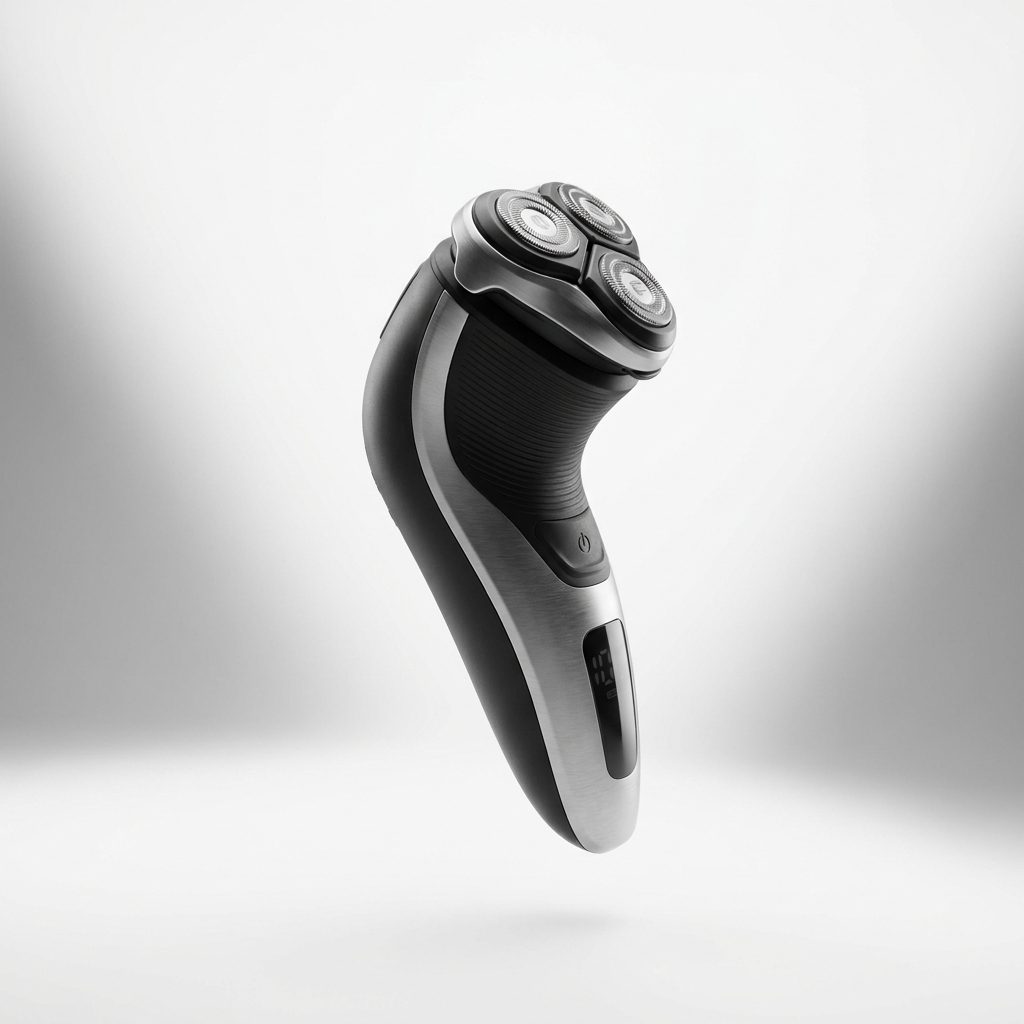
The Arc5 is Panasonic's flagship electric shaver and the brand's direct competitor to Braun's Series 9 Pro. The ES-LV97-K is the version sold with Panasonic's automatic clean & charge station and its 16-D flexible head.
The "Arc" name refers to the arced foil design — the cutting foils follow a curved geometry that matches the contour of a typical male jaw and cheek. Five stainless steel inner blades, precision honed to an acute 30 degrees, work beneath an outer foil system that Panasonic says lifts, captures and cuts even thick, dense beards — so the head addresses multiple hair lengths and angles in a single pass.
Shave Closeness — The Headline Result
The Arc5 is consistently ranked among the closest electric shavers in the category. The 30-degree honed inner blades are a key variable, and the shave sensor — which Panasonic says reads beard density 220 times a second and adjusts power 14 times a second — keeps cutting speed up in dense areas. The Arc5's five-blade system with dedicated foils for different hair orientations captures more of the flat-lying hairs that other shavers miss.
For men who can tolerate a two-week adaptation period (electric shaver adaptation is real — skin takes time to adjust), the Arc5 ultimately delivers a shave that regularly gets described as "surprisingly close to blade shaving." That's accurate.
The Linear Motor Advantage
Most electric shavers use rotary or pivot motors that convert rotational motion into oscillating blade movement through a mechanical linkage. Panasonic's linear motor eliminates this conversion: the motor output is directly linear, meaning the blade oscillates back and forth with no mechanical translation losses. Panasonic rates it at up to 70,000 cross-cuts per minute.
Higher CPM means each hair is cut more rapidly and with less traction force against the skin. This reduces the pulling sensation that some men feel with electric shavers and decreases the skin stress per shaving stroke. The linear motor also maintains consistent speed under blade load — when you're shaving denser beard areas, the motor doesn't slow down as some pivot motors do under resistance.
The trade-off is cost: replacement parts are not cheap. Panasonic's WES9032P blade and foil set — listed as compatible with the ES-LV97 — was about $62 on Amazon when we checked, and Panasonic suggests replacing it every one to two years, so budget for it alongside Braun's equivalent cassettes if you are comparing running costs.
Arc5 vs Braun Series 9 Pro+
Which Panasonic Arc Should You Buy?
The Arc5 is sold in several versions, and the cheapest one isn't the one we review. All of these are sold by Amazon; prices were checked on Oct 4, 2026.
| Model | What you get | Price |
|---|---|---|
| Arc5 ES-LV65 (no station) | 5 blades, pop-up trimmer, 10-stage LCD battery display | $180 |
| Arc5 ES-LV97 (reviewed) | 5 blades, 16-D head, automatic clean & charge station | $238 |
| Arc5 palm shaver ES-PV3A | 5 blades in a palm-sized body, USB-C, 50 min per charge | $300 |
| Arc6 ES-LS8A | 6 blades, 84,000 cross-cuts/min, 50 min per charge | $400 |
Our pick: the ES-LV97 if you want the cleaning station; otherwise the ES-LV65 saves about $58 for the same five-blade system. The Arc6 is Panasonic's six-blade flagship if money is no object.
Running Costs
The one recurring cost is the blade and foil set. Panasonic recommends replacing it every one to two years; at about $62, that is roughly $30 to $60 a year.
Alternatives Worth Considering
| Shaver | Highlights | Price |
|---|---|---|
| Braun Series 9 Pro+ | Foil — 5+1 foil system, beard sensor 300×/sec, 6-in-1 SmartCare center | $300 |
| Philips Norelco S9000 Prestige | Rotary — Self-sharpening blades, Quick Clean Pod, up to 5-year warranty | $230 |
| Braun Series 7 7075cc | Foil — 360° flex head, SmartCare center, 50 min battery | $160 |
Not sure whether foil or rotary suits your beard? Read our foil vs rotary guide, or see the full Braun Series 9 Pro+ review.
Is It Worth the Price?
The Arc5 ES-LV97 costs around $238 on Amazon, sold by Amazon, and that price includes the automatic clean & charge station — so the station convenience comes without a separate purchase. Against the Braun Series 9 Pro+, it delivers comparable shave closeness for less money.
The Braun's Lift&Cut blade and built-in ProTrimmer are its main advantages, particularly for flat-lying neck hair. If that is your problem area, the Series 9 Pro+ premium can be justified. Otherwise the Arc5 ES-LV97 is the better value, especially with its cleaning station included.
- →You want the closest possible electric shave
- →You prefer Japanese engineering to German
- →You want a clean & charge station included
- →You shave wet (foam/gel in the shower)
- →Flat-lying neck hair is your main problem (go Series 9 Pro+)
- →Budget under $200 (consider the Braun Series 7 or the cheaper Arc5 without a station)
- →You have very sensitive skin (broader foils are gentler)
- →You want simplest possible daily use
Frequently Asked Questions
Is the Panasonic Arc5 worth it?
If you want one of the closest electric shaves available, yes. At about $238 with the cleaning station — or about $180 without — it costs less than the Braun Series 9 Pro+.
Arc5 or Braun Series 9 Pro+?
Both shave very close. The Arc5 costs less; the Series 9 Pro+ has a built-in trimmer for flat-lying neck hair and a beard sensor that reads 300 times a second.
How often should I replace the Arc5 foil and blades?
Panasonic recommends every one to two years. The WES9032P set fits the ES-LV97, ES-LV67, ES-LV95 and ES-LV65.
Can you use the Arc5 in the shower?
Yes. It is a wet/dry shaver you can use with foam or gel or in the shower.
What is the difference between the Arc5 and Arc6?
The Arc6 has six blades and Panasonic rates it at 84,000 cross-cuts per minute, against five blades and up to 70,000 for the Arc5. It costs about $400.