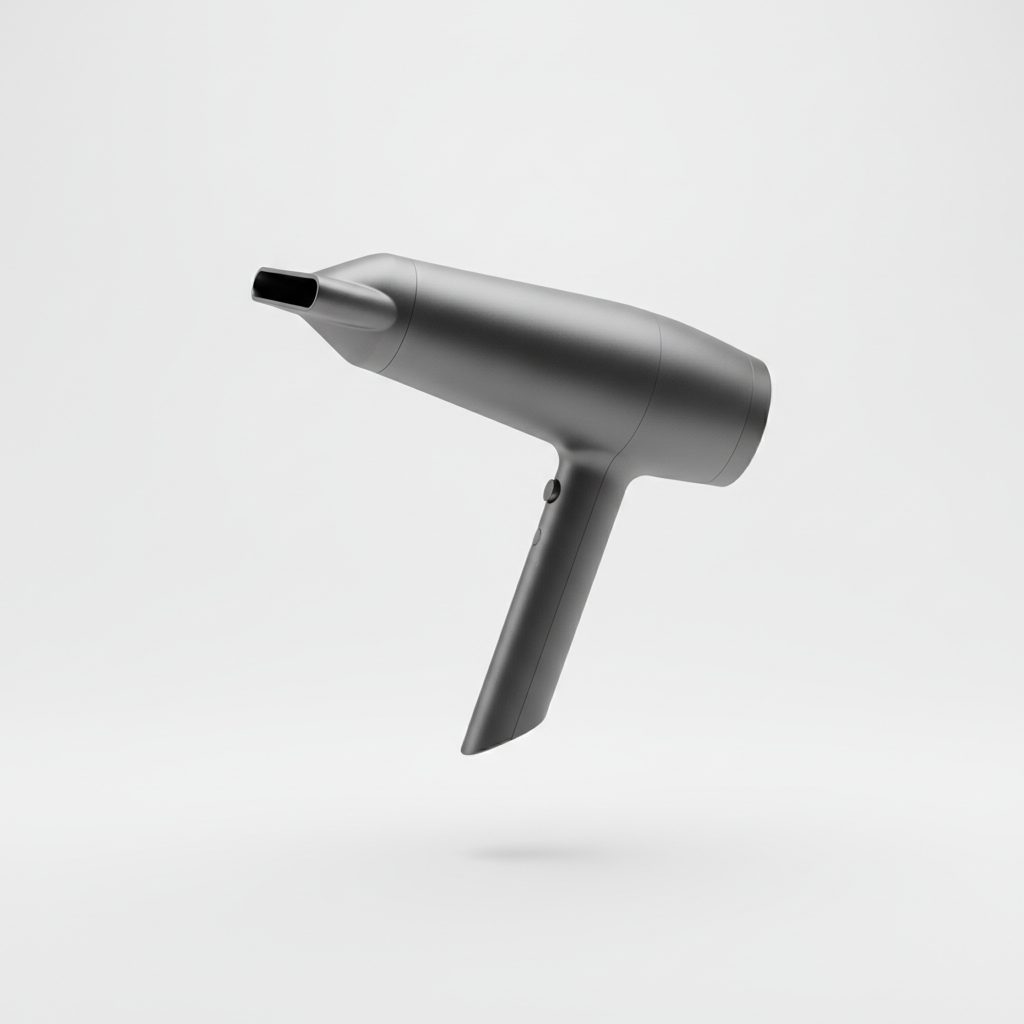
The hair dryer is the most underrated tool in men's grooming. The right device doesn't just speed up drying — it shapes, controls frizz, and sets your style with precision impossible to achieve air-drying. We ranked the five best men's hair dryers of 2026 by motor technology, heat distribution, ionic output, and attachment ecosystem, so you can dry faster and damage less.
Why Motor Type Determines Everything
Hair dryers use two fundamentally different motor architectures: AC (alternating current) and DC (direct current). AC motors — found in many salon-grade dryers — run at fixed high speeds (typically 20,000+ RPM), are heavier, last longer under daily professional use, and produce more consistent airflow. DC motors — found in Dyson and most consumer dryers — are lighter, quieter, and can be electronically speed-controlled, enabling the precise heat management that defines premium consumer devices.
Dyson's digital motor spins far faster than a conventional AC motor, which allows it to be physically much smaller (it fits in the handle) while moving the same volume of air. The tradeoff is cost: precision digital motors are expensive to manufacture, which is why the Dyson costs around $400 rather than $50.
Ionic Technology: What It Actually Does
Hair carries a net positive charge when wet, particularly after washing with certain shampoos. Positively charged strands repel each other, creating frizz and flyaways as the hair dries. Ionic generators — either ceramic tourmaline plates or dedicated electronic emitters — release a continuous stream of negatively charged ions into the airflow. These ions neutralize the positive charge on the hair shaft, causing the cuticle to lie flat rather than bristle outward. The result is smoother, shinier hair with less static. The difference is visible and tactile, not marketing.
How to Dry Hair without Damaging It
Three rules that apply regardless of which dryer you own:
- Keep the nozzle moving. Static heat concentrated in one spot raises local temperature above the protein denaturation threshold (around 230°C for keratin). Continuous motion distributes heat evenly.
- Point downward. Directing airflow down the hair shaft — from roots to ends — pushes the cuticle flat rather than lifting and roughing it. This alone reduces frizz without any additional product.
- Finish cold. The cold-shot button exists for a reason. Closing the cuticle with cold air after styling locks the shape and increases shine measurably.
Best Hair Dryer for Men 2026 — The Rankings
1. Dyson Supersonic Origin ($400)
The Dyson Supersonic remains the engineering benchmark for hair dryers, and the Origin edition is the most affordable way into it. Dyson puts a small, powerful digital motor in the handle rather than the head, creating a lighter, better-balanced device than dryers with the motor at the nozzle, and its Air Multiplier technology produces a high-pressure, high-velocity jet of controlled air for fast drying and precise styling. The dryer measures air temperature more than 40 times a second and regulates the heat to prevent extreme heat damage, across four heat settings (212°F, 176°F, 140°F and an 82°F constant cool) and three airflow speeds, and negative ions help reduce static. The Origin package includes the magnetic styling concentrator, which stays cool to the touch thanks to Heat Shield technology — Amazon's listing mentions no other attachments. Few dryers control heat as precisely.
Strengths: Handle-mounted motor (balance) · Heat measured 40+ times a second · 4 heat / 3 airflow settings + cool shot · Air Multiplier high-velocity airflow · Magnetic, cool-touch concentrator
Limitations: ~$400 price point · Origin ships with one attachment · Overkill for very short hair
2. Shark SpeedStyle (HD331) ($150)
Shark's SpeedStyle is the most compelling alternative to Dyson at well under half the price. Its styling attachments are recognized by the dryer, which automatically adjusts heat and airflow to suit each tool, and Shark says it regulates temperature 1,000 times a second to stay below 230°F. It has four heat settings, three airflow speeds and a cool shot, and weighs just 1.69 lb. This bundle comes with a RapidGloss Finisher, a QuickSmooth brush and a Turbo Concentrator, and Shark pitches it at fine to medium, straight and wavy hair — which covers most men's cuts. (Shark's HyperAir IQ, which held this spot, is currently only available on Amazon from resellers.)
Strengths: Auto-adjusting smart attachments · Heat regulated 1,000x/sec, under 230°F · 4 heat / 3 airflow + cool shot · 1.69 lb — light in the hand · Well under half the Dyson price
Limitations: Bundle aimed at fine-to-medium hair · Brush attachments are surplus for short cuts · Less heat range than the T3
3. T3 AireLuxe ($191)
T3's AireLuxe pairs digitally controlled heat with ion-rich airflow for fast drying that preserves moisture. Its ion generator produces 10 million negative ions per second to neutralize static, smooth the cuticle and reduce frizz, and five heat and three speed settings — gentle for fine or color-treated hair, higher for thick or coarse hair — plus a lock-in cool shot give it the widest range here. This set also includes a paddle brush and a 2.5-inch round brush. For men with coarse, thick or chemically processed hair who want professional-level results without the Dyson price, this is the pick. (T3's Cura LUXE, which held this spot, is not currently listed on Amazon US; the AireLuxe is the T3 dryer Amazon sells now.)
Strengths: Digitally controlled heat · 10 million ions/sec anti-frizz · 5 heat / 3 speed + cool shot · Great for coarse/thick hair · Paddle + round brush included
Limitations: Premium mid-range price · Brush set is surplus for short cuts · No published heat-sensing rate
4. Remington Damage Protection ($23)
The Remington Damage Protection dryer is the answer to one question: what's the best hair dryer under $40? Its Micro-Conditioner Technology and ceramic, ionic and tourmaline technologies aim at the same result the premium dryers chase — smoother, frizz-free, shinier hair — and Remington claims three times more protection. The 1875W motor is sufficient for most men's hair textures, with three heat and two speed settings, a cool shot, a removable filter, and both a concentrator and a diffuser in the box. It won't replace a Dyson, but for men with short to medium hair who want something reliable without spending $150 or more, it does the job at around $23.
Strengths: Micro-Conditioner Technology · Ceramic + ionic + tourmaline · 1875W for quick drying · Exceptional value at ~$23 · Concentrator + diffuser included
Limitations: No precision heat sensing · Only 2 speed settings · Struggles with very thick hair
5. BaBylissPRO Nano Titanium ($80)
BaBylissPRO builds dryers for salon professionals, and this 2000W Nano Titanium model is built for regular, everyday use. Nano Titanium technology and a true ion generator reduce static and frizz for smooth, shiny results, and BaBylissPRO says the even heat distribution helps protect hair from heat damage — useful for men with textured, coarse or thick hair that takes longer to dry. Six heat and speed settings and a cool-shot button give plenty of control, and it weighs just 1.05 lb with a flexible 9-foot cord and a removable rear filter. At around $80, this is the pick for men who take their hair seriously but aren't willing to pay Dyson prices.
Strengths: Salon-grade 2000W motor · Nano Titanium + true ion generator · 6 heat/speed settings + cool shot · Only 1.05 lb · Great for textured/coarse hair
Limitations: No intelligent heat sensing · Long 9-ft cord (salon length) · Fewer attachments than the Shark or T3
Comparison Table
| PRODUCT | STANDOUT | TRADE-OFF | PRICE |
|---|---|---|---|
| Dyson Supersonic Origin | Handle-mounted motor (balance) | ~$400 price point | $400 |
| Shark SpeedStyle (HD331) | Auto-adjusting smart attachments | Bundle aimed at fine-to-medium hair | $150 |
| T3 AireLuxe | Digitally controlled heat | Premium mid-range price | $191 |
| Remington Damage Protection | Micro-Conditioner Technology | No precision heat sensing | $23 |
| BaBylissPRO Nano Titanium | Salon-grade 2000W motor | No intelligent heat sensing | $80 |
Related reading: Best Hair Pomade for Men 2026.
Related guide: how to blow-dry men's hair.