HAIR
—
JUNE 26, 2026
Best Hair Gel for Men 2026 — Hold, Shine and Wet Look Ranked
Hair gel is the most technically honest styling product in men's grooming. It does exactly what the chemistry says it will: film-forming polymers coat the hair shaft, water evaporates, and the remaining polymer network locks everything in place. The hold isn't marketing. The shine isn't branding. It's refractive index. What separates a good gel from a bad one is the specific polymer blend, the cross-link density, and whether the formulation has been calibrated for the hair type it claims to suit. We assessed the leading gels on the market on hold, finish, restyling ability and hair-type fit, using manufacturer specifications and documented owner reports, and ranked them accordingly.
We may earn a commission from links on this page.
Hair Gel Chemistry: Polymers and Hold
Hair gel is a suspension of film-forming polymers in water, thickened to a gel consistency. Understanding what those polymers are and how they behave is the fastest route to buying the right product for your hair type and style.
Film-Forming Polymers: PVP, VP/VA, and Acrylates
The three main classes of hold polymer in commercial styling gels are polyvinylpyrrolidone (PVP), vinyl pyrrolidone/vinyl acetate (VP/VA) copolymer, and acrylates. PVP is the most widely used: it forms a hard, transparent film when dry and is highly water-soluble. VP/VA copolymer is PVP with vinyl acetate units incorporated into the polymer chain — the acetate groups interrupt the rigid PVP structure, introducing flexibility into the dried film. Acrylates (typically listed as acrylates/C10-30 alkyl acrylate crosspolymer or similar) create the most flexible, often the most conditioning-feeling films — they are used in professional formulations where movement after hold is a specific design objective. The formulation ratio between these polymers determines almost everything you experience when you use a gel: how hard it sets, whether it flakes, and whether your hair feels alive or embalmed.
How Polymers Cross-Link Around the Hair Shaft
When gel is applied to wet or dry hair, the polymer molecules disperse through the water phase and coat the surface of each hair shaft. As water evaporates — which happens rapidly on dry hair and more slowly on wet — the polymer concentration increases until the molecules begin to make contact and form a continuous network. The result is a thin film that encases the hair shaft and bonds adjacent hairs together at contact points, creating the structural rigidity we call "hold." The density of cross-linking within this network is the direct determinant of hold strength: more cross-links per unit of polymer film equals higher hold, less flexibility, and a higher probability of flaking when the film is stressed.
Hold Strength and Cross-Link Density
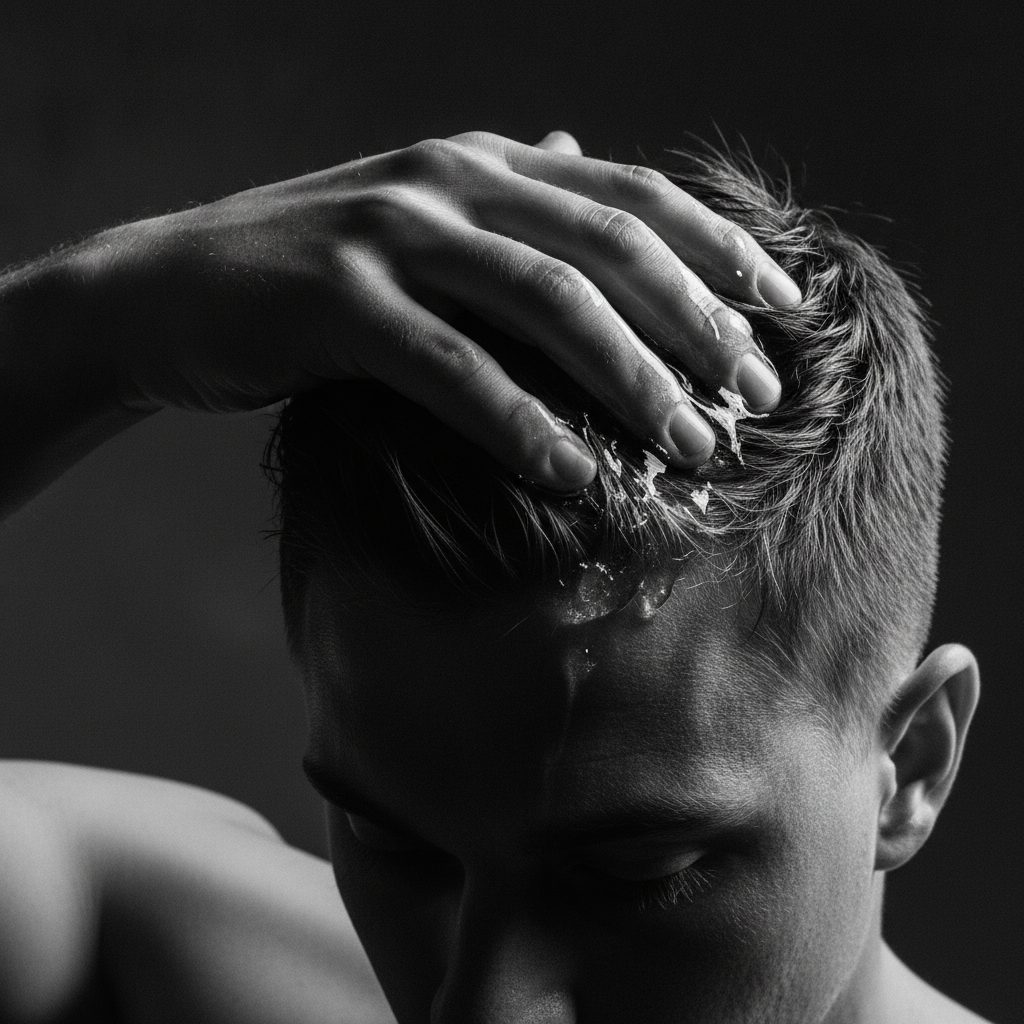
This is the principle that explains why maximum-hold gels flake. High carbomer concentration drives very high cross-link density. The dried film is essentially a continuous rigid matrix. When the hair flexes — due to movement, wind, or touching — the film experiences shear stress. If the stress exceeds the film's elastic limit (which is very low at high cross-link density), the film cracks and releases small fragments: the white flakes you see on the collar. The solution is not to use less product — it is to select a formulation with a lower cross-link density (less carbomer, more VP/VA or acrylate co-polymer), which provides adequate hold with sufficient flexibility to survive normal hair movement without fracturing.
Wet vs Dry Application
Applying gel to wet hair versus dry hair produces meaningfully different outcomes — not because the product changes, but because water alters the distribution dynamics. On wet hair, the gel dilutes slightly and spreads more evenly across a larger surface area. Polymer contact with the hair shaft increases proportionally. As both the existing water and the water in the gel evaporate together, a more uniform, denser polymer film forms. The result is stronger hold and more even shine. Applying the same gel to dry hair produces a lighter hold: the gel sits on the outer surface of the hair and distributes less uniformly, so the polymer film is thinner and less cohesive. Both approaches are valid — the choice depends on whether you need structural hold or a lighter, more natural-looking result.
Why Gels Create Shine
The wet look that gels produce is a direct consequence of polymer film optics. The dried polymer film — PVP, VP/VA, acrylates — has a refractive index above 1.5, significantly higher than air (1.0) and even the hair cortex itself. This creates a sharp optical interface at the hair surface that reflects light specularly rather than diffusely. Diffuse reflection (as seen with matte clays) occurs when the surface is microscopically rough, scattering light in multiple directions. Specular reflection occurs when the surface is smooth and flat — as a continuous polymer film is — and sends most incoming light back in a single coherent direction, which the eye reads as gloss or "wet look." The more complete and even the polymer film, the higher the shine level. Maximum-hold, high-carbomer gels produce the highest shine because they form the densest films. Flexible-hold professional gels produce a cleaner, more natural shine because the thinner film has less total reflective surface area.
The Crunch Problem — and How to Fix It
Over-dried gel with a high carbomer content causes the polymer film to become audibly brittle under movement — a phenomenon known as crunch. The hair feels stiff, rigid, and plasticky. The fix is mechanical: once the gel is fully dry, cup your hands over the styled hair and apply even compressive pressure while scrunching gently. This deliberately fractures the surface film in a controlled way, breaking it into microscopically small pieces that blend into the hair rather than releasing as visible white flakes. The resulting texture is softer and more natural-looking while retaining a significant proportion of the original hold. This technique is standard in professional barbering but rarely communicated on product packaging.
Water-Solubility — The Myth of Hard-to-Wash Gel
All modern styling gels are water-soluble. PVP, VP/VA, acrylate crosspolymers — every major hold polymer class dissolves readily in water, which means every gel on this list washes out with a single shampoo application. The myth of gel being hard to wash out is a legacy from the era of heavy wax-based pomades, which resist water and require clarifying shampoos or multiple washes to remove. Water-based gels and water-based pomades share this property: water breaks the polymer network immediately. If you experience difficulty washing out a gel, the issue is product accumulation (using too much over multiple days without washing) rather than the polymer chemistry itself.
Matching Gel to Hair Type
Fine hair is the most problematic hair type for heavy gels. The lower mass-per-strand of fine hair means the hair shaft bends more easily under the weight of the polymer film, and the polymer film — with higher density relative to the hair's natural structure — is more likely to crack under that bending stress and flake. Fine hair benefits from gels with lighter VP/VA-dominant formulations (less carbomer, more acrylate co-polymer) and lighter application. Coarse or thick hair can accommodate and benefit from denser cross-linked formulas: the additional polymer mass is proportionally less significant relative to the hair's own structural stiffness, and the stronger hold is needed to work against the hair's natural tendency to revert. Curly hair is a special category: water-based gels are among the most effective styling products for defining curl patterns, where the film-forming polymer follows and reinforces the curl structure rather than fighting it.
Gel vs Pomade vs Clay — Which Do You Need?
Hair gel is the right tool for specific jobs — wet looks, maximum definition, hard hold that does not require restyling. It is the wrong tool for matte finishes, casual texture, or styles that need significant reshaping throughout the day. Understanding where gel ends and where other styling product categories begin will save you from buying a product that is chemically incapable of producing the result you want.
| PRODUCT TYPE |
HOLD |
FINISH |
RESTYLING |
WASHOUT |
BEST FOR |
| Hair Gel |
Medium–Max |
High shine |
No |
Easy |
Slick looks, wet look, definition |
| Water-Based Pomade |
Light–Firm |
Shine |
Yes |
Easy |
Classic styles, flexibility |
| Clay |
Medium–Firm |
Matte |
Partial |
Easy |
Texture, modern cuts, matte finish |
| Oil-Based Pomade |
Light–Firm |
High shine |
Yes |
Hard |
Old school, classic looks |
| Hair Wax |
Light–Medium |
Low shine |
Yes |
Medium |
Textured, messy styles |
The key decision variables are finish and restyling. If you want shine, gel or pomade is the correct category. If you want matte, clay is the only option — no gel will produce a matte result because the polymer film always produces at least some specular reflection. If you need to restyle throughout the day, gel is almost always the wrong choice: the cross-linked polymer network, once set, cannot be reshaped without adding water. Water-based pomade and wax are the correct categories for restyling ability.
Gel's genuine strengths are hold strength, shine level, and longevity of set. In those three dimensions, no other styling category competes. For a slick back, a pompadour, a hard-set side part, or any style that needs to hold for 8–12 hours in a demanding environment, gel is the technically correct choice.