Shaving your head is not shaving your face with a bigger stroke. It is a different geometry problem, and most of the frustration men report in their first month of head shaving traces back to using a tool designed for a jawline on a surface that behaves nothing like one.
A face has landmarks — a jaw edge, a chin, a defined neck line. A scalp is a continuous compound curve with no edges, roughly three to four times the surface area, and you are working on it blind, by feel, at wrist angles that a face shaver was never designed to reach. This guide ranks the tools by the thing that actually determines the result: head geometry and how the blades track a dome.
Why a Face Shaver Struggles on a Scalp
Contact patch. A shaver head that sits flat on a cheek sits tangent to a sphere on a skull — touching along a much smaller contact patch. Less of the cutting surface is engaged per stroke, so you make more passes, and more passes over the same skin is the direct cause of the razor burn most new head shavers blame on the blade.
Wrist angle. The back of the head and the area above the nape require you to invert your grip. A conventional handle puts your wrist at the end of its range there, and a wrist at end-of-range applies uneven pressure — usually too much. This is the specific problem the palm-grip head shavers were designed to solve.
Growth direction. Scalp hair does not grow in one direction. It typically radiates from one or more whorls, which means the "against the grain" stroke changes direction several times across a single head. There is no universal stroke pattern; you have to map your own.
Rotary vs Foil on a Dome
Rotary heads are circular cutters, usually three to five of them, each mounted on an independent float. That independent suspension is the mechanical reason rotary dominates head shaving: each head can sit at its own angle, so the array conforms to a curved surface instead of bridging across it. Rotary also cuts multidirectional growth well, which matters on a scalp with whorls.
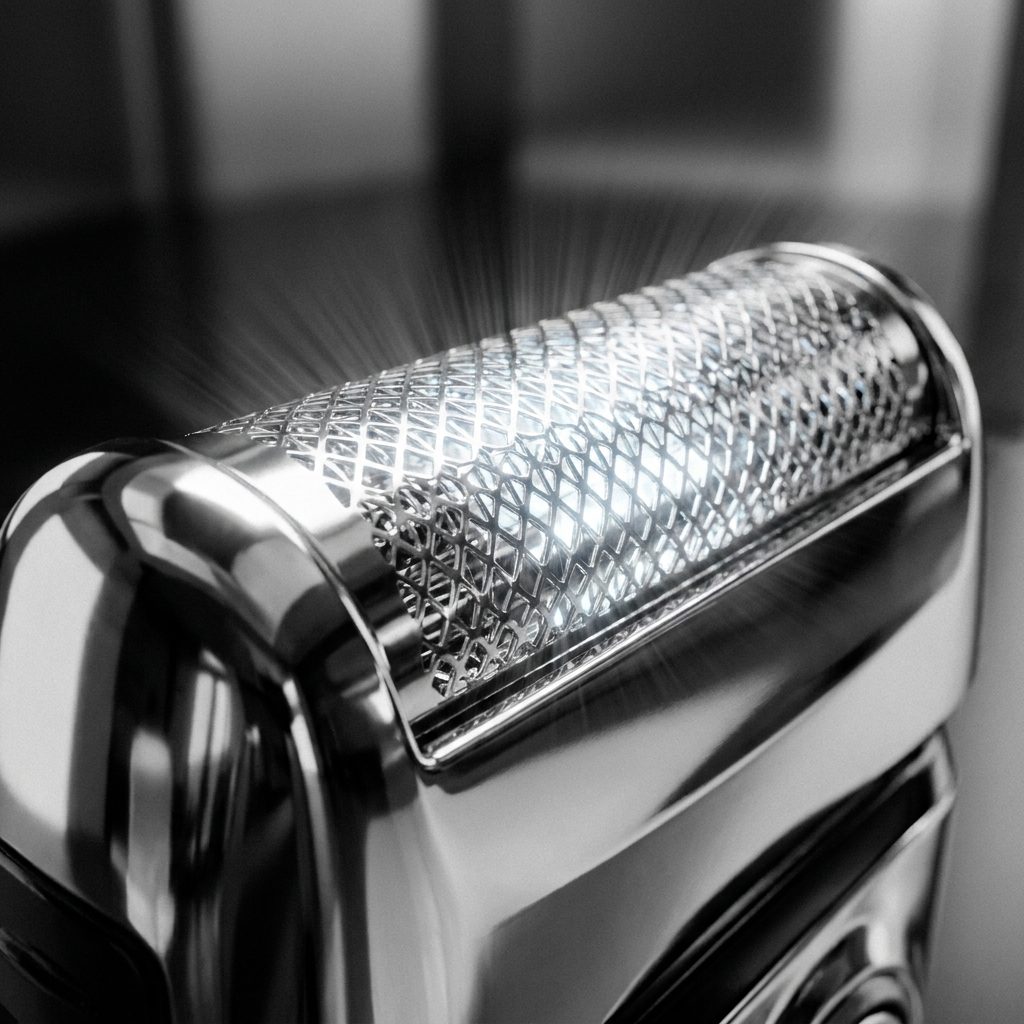
Foil heads cut through a perforated screen with an oscillating blade underneath. The cutting action is linear and the head is a flat or gently curved plane. On a flat surface a foil gives a closer, more uniform cut with less irritation — the screen holds the skin flat and the blade never touches it. On a dome, a foil bridges the curve and needs more passes, but for men whose scalps react badly to rotary — folliculitis, persistent razor bumps, visible irritation — a premium foil is often the better trade.
The short version: rotary for speed and contour, foil for comfort on reactive skin.
The Specifications That Actually Matter
- Head float and blade count. More independently floating cutters means better conformity on a curved surface. Four or five is the practical range for a dedicated head shaver.
- Waterproofing rating. IPX7 means the unit is rated for immersion, which in practice means you can shave in the shower and rinse the head under a tap. Shower shaving with a lubricant is the single biggest comfort upgrade available to a head shaver, and it requires the rating.
- Runtime. A head takes longer than a face. Runtime under about 30 minutes means charging every two or three shaves; 90 minutes means charging monthly.
- Grip geometry. The palm-grip format used by Skull Shaver and Freebird puts the cutting head under your palm rather than at the end of a handle, which keeps the wrist neutral on the back of the skull.
- Replacement head cost. Cutters dull. Check the price and availability of replacement heads before buying — on some models the annual consumable cost approaches a third of the device price.
Best Head Shavers for Bald Men 2026 — The Rankings
1. Skull Shaver Pitbull Gold PRO ($121) — BEST OVERALL
The Pitbull Gold PRO is the reference design for the category. Four rotary cutters on an independently floating head, an IPX7 rating that makes shower use viable, and a listed 90 minutes of cordless runtime. The defining feature is the grip: you slide two fingers into slots on the top of the body and the shaver sits in your palm, which puts the cutting head directly under the pressure point and keeps your wrist neutral when you reach the back of the skull. It takes a few sessions to stop feeling strange. Once it does, the reduction in wrist fatigue is the main reason men who shave daily stay with this format. Best for: daily head shavers, anyone who shaves in the shower.
2. Freebird FlexSeries Pro ($100) — BEST FOR SPEED
Freebird's four-blade head uses a convex arrangement — the cutters sit on an outward curve rather than a flat plane, which matches the shape of a skull rather than fighting it. The practical consequence is fewer strokes for full coverage, and Freebird builds its marketing around a sub-two-minute head shave. Runtime is in the same 90-minute class as the Pitbull. The same palm-grip logic applies. It is the closest direct competitor to the Skull Shaver and the choice comes down to which grip shape suits your hand. Best for: men who want the shave over quickly, larger head sizes.
3. Remington Balder Pro ($70) — BEST VALUE
Five dual-track rotary heads on independent pivots, at roughly half the price of the premium palm-grip options. The dual-track design puts a comb ahead of each cutter to lift and pre-cut longer growth, which helps if you are shaving down several days of stubble rather than maintaining daily. The compromise is battery: expect roughly 25 minutes of runtime rather than 90, which means charging every couple of shaves. For a man who shaves his head twice a week rather than daily, that is a non-issue and the saving is real. Best for: budget buyers, twice-weekly maintenance, shaving down longer growth.
4. Braun Series 9 Pro+ ($380) — BEST FOR A REACTIVE SCALP
A foil shaver rather than a dedicated head shaver, and the answer for men whose scalps break out in bumps after every rotary pass. The five-element head includes Braun's ProLift trimmer, which combs flat-lying hairs upright before the foils reach them — the specific mechanism that lets a foil clear a scalp without the repeat passes that cause irritation. You will spend longer on the dome than with a rotary, and the back of the head is harder to reach with a conventional handle. If your problem is folliculitis rather than speed, that trade is worth making. Full breakdown in our sensitive skin shaver guide. Best for: razor bumps, ingrown-prone scalps, men who also shave their face with it.
5. Philips Norelco Shaver 9000 Prestige ($320) — BEST ROTARY FOR CONTOURS
Philips' top rotary platform, with individually floating heads and a pressure-sensing system that signals when you are pushing too hard — genuinely useful on a scalp, where you cannot see what you are doing and over-pressure is the most common technique error. Wet and dry capable, with around 60 minutes of runtime. It is a face shaver by design and carries a conventional handle, so the nape remains awkward, but the head conformity is excellent and it doubles as a face shaver without compromise. Best for: men shaving both head and face who want one premium device.
Technique: How Not to Shred Your Scalp
Map your growth first. Before the first pass, run a dry hand over your scalp in several directions and find where the resistance changes. Those are your whorl boundaries. Your stroke direction needs to change at each one.
First pass with the grain, always. Reducing length before you chase closeness is what separates a clean shave from a week of bumps. If you are shaving down more than two or three days of growth, run clippers first.
Shave wet, with a lubricant. Dry shaving a scalp increases friction across a large surface area. A shower shave with a slick gel or a dedicated head-shave cream reduces drag substantially — which is why the IPX rating matters more here than on a face shaver.
Stretch the skin. Use your free hand to pull the skin taut ahead of the head. A taut surface presents hairs more uprightly and stops the cutter from catching loose skin — particularly around the nape and behind the ears.
Stop when it is done. The strongest temptation in head shaving is the extra pass over an area that feels almost smooth. That pass is where the irritation comes from. Accept ninety-five percent.
Aftercare — The Part Most Men Skip
A freshly shaved scalp is newly exposed skin on the highest, most sun-exposed plane of the body, and it has just been mechanically exfoliated. Two things follow from that.
First, sun protection is not optional. The scalp receives more direct UV than almost any other site, and a shaved scalp has no hair to diffuse it. A daily broad-spectrum SPF on the head is the highest-value habit in this entire routine — see our SPF guide for men for formulations that do not leave a white cast.
Second, treat it like post-shave skin, because it is. An alcohol-free balm restores the barrier you just disrupted; an alum block handles minor weepers and has mild antiseptic action. If you get recurring bumps, the mechanism and the fixes are covered in our guide to preventing ingrown hairs, and the balm rankings are in best aftershave and post-shave.
For the wider device category — face shavers, trimmers and grooming hardware — see the Devices hub, our best electric shavers ranking, and if hair loss rather than choice brought you here, men's hair loss treatments covers what the evidence supports.
Prices are approximate US street prices at the time of writing and move frequently. Specifications are as published by each manufacturer.