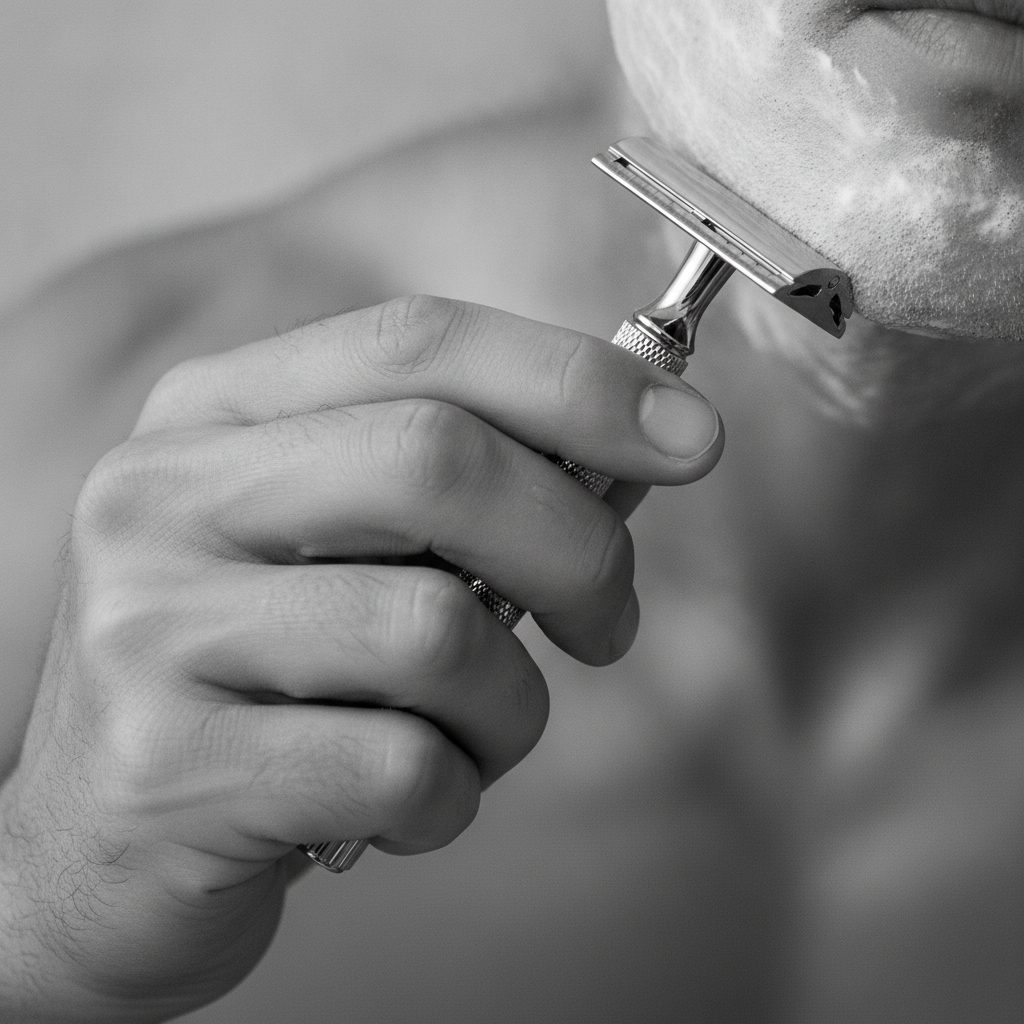
Most men who try a safety razor and abandon it within a week do so because nobody explained the physics. They applied cartridge razor technique — pressure, fast strokes, pivot-compensated angle — to an instrument that requires precisely the opposite approach. The result is cuts, irritation, and a conclusion that safety razors are antiquated, difficult, and not worth the effort. That conclusion is wrong. The technique is what failed, not the tool.
A double-edge razor requires two variables to be calibrated correctly: angle and pressure. Get those two right and everything else follows. This guide explains both from first principles and builds the complete technique from preparation through post-shave protocol, step by step.
The Physics Before You Start — Why DE Technique Is Different
A cartridge razor is an engineered compensation system. The pivoting head adjusts for angle variations so a wide range of blade-to-skin angles still produce a shave. Spring-loaded guards reduce direct blade-to-skin contact, distributing force across multiple pressure points. Multiple blades create redundancy — if one blade misses a hair, the next will catch it. You can apply pressure because the mechanical system absorbs and corrects for it. The cartridge razor is designed to tolerate bad technique.
A safety razor has none of these corrections. The head does not pivot. There is one blade. There is no spring-loaded guard. Angle errors translate directly to ineffective cutting or nicks. Pressure errors translate directly to irritation, razor burn, and weepers (minor bleeding cuts from too much contact force). The safety razor does not forgive technique errors — which is also why the ceiling of shave quality it can deliver is significantly higher. A cartridge system compensates for bad technique at the cost of shave quality. A DE razor rewards good technique with the closest, cleanest shave mechanical shaving can produce.
The critical mindset shift: a DE razor does not require you to do more. It requires you to do less. Less pressure, shorter strokes, slower pace. The razor does the work; your job is to maintain angle and move correctly.
Step 1 — Prepare the Beard
Facial hair in its dry state is approximately as stiff as copper wire of equivalent diameter. Properly hydrated facial hair is 70% easier to cut — a figure derived from studies of hair tensile strength under varying hydration conditions. Hot water (45°C and above) soaks into the hair shaft, causing it to swell and soften dramatically. This is not marginal — it is the difference between the blade gliding through hair and the blade dragging against resistant fiber.
The optimal preparation is a hot shower immediately before shaving. The steam and hot water exposure for 5–10 minutes achieves the maximum hydration state. If showering before shaving is not practical, splash hot water on the face repeatedly for 60–90 seconds — rinse, splash, hold, repeat. A hot wet towel applied for two minutes achieves similar results. Cold water preparation is a persistent myth: cold water does not "tighten pores" in any way that is beneficial for shaving. It stiffens the hair and the skin, increasing resistance and the likelihood of irritation.
Step 2 — Map Your Beard Growth Direction
Beard hair does not grow uniformly downward. The growth direction varies between cheek, jaw, neck, and upper lip, and in many men it varies significantly even within a single zone. Shaving against the grain before mapping it is the primary cause of ingrown hairs and neck irritation.
The mapping process takes 60 seconds and only needs to be done once. Run your fingertip lightly across your unshaved face in different directions. The direction that feels smooth — where your fingertip slides without resistance — is with-the-grain (WTG). The direction that feels rough and catches slightly is against-the-grain (ATG). Map three zones separately: cheek, jaw/chin, and neck. Most men find that their neck in particular has an inconsistent or upward growth direction that surprises them.
First shave pass: always WTG across the entire face. This is non-negotiable, regardless of how comfortable you become with DE technique. Second pass (optional for a closer shave): across-the-grain (XTG) — perpendicular to the growth direction you mapped. Third pass (optional, experienced shavers with zero-irritation faces only): ATG — against the grain for baby-butt smooth (BBS) result. Never proceed to ATG if your skin shows any redness from previous passes.
Step 3 — Build a Proper Lather
Canned shaving foam is a convenience product with a significant performance gap compared to brush lather. The propellants in aerosol foam (isobutane, propane) create volume without viscosity, and the lubricant concentration is lower than a quality shaving soap or cream worked into lather by a brush. More critically, canned foam sits on top of the skin. A brush works the lather into the beard, coating each hair shaft and lifting them away from the skin surface — this is what allows the blade to catch each hair at its base rather than mowing them flat against the skin.
A synthetic shaving brush loaded with a quality soap (Proraso, Taylor of Old Bond Street, Arko, Mitchell's Wool Fat) or cream produces structural lather that is visually distinct from foam: it holds peaks, it has body, it does not collapse. The correct lather consistency is between whipped cream and thick yoghurt. Too wet and it runs off the face. Too dry and it does not provide adequate lubrication for the blade. Load the brush for 30 seconds on the soap, then work the lather directly on the face for another 30 seconds — this is face lathering, which achieves the best beard penetration.
Step 4 — The Correct Blade Angle (The Most Important Variable)
Thirty degrees. This is the single most important number in DE shaving technique and it represents the angle between the razor handle and the skin surface. Not the blade — the handle. The head geometry of most quality safety razors is designed so that when the handle is at approximately 30 degrees from the face, the blade is at the optimal cutting angle relative to the skin.
Finding 30 degrees in practice: place the cap of the razor (the top of the head) flat against your cheek with the handle pointing outward, roughly parallel to the floor. This is too flat — the blade is not engaged. Slowly rotate the handle downward and away from your face, keeping the cap in contact with the skin. At some point you will feel the blade begin to engage — a subtle change in resistance. That point is approximately 30 degrees. Stop there.
Test the angle before applying to your face with lather. Try one short stroke on the side of your neck and assess: if hair is removed cleanly with no friction sensation and no skin irritation, the angle is correct. If there is friction but no cutting, the angle is too shallow — increase it slightly. If there is immediate skin sensitivity, the angle may be too steep — reduce it. The 30-degree principle is consistent across most mainstream safety razor designs, but individual head geometry varies, and your specific razor may want 28 or 32 degrees. Let the feel tell you.
Step 5 — Zero Pressure
The weight of a quality safety razor — typically 90g to 120g — is exactly sufficient cutting force for beard hair on properly prepared skin. No additional hand pressure is needed. This is not an approximation or a guideline with wiggle room. It is a functional fact of the mechanics: adding pressure beyond the razor's own weight increases the contact force between blade and skin, multiplying friction and causing the micro-abrasion that results in razor burn, redness, and weepers.
Achieving zero pressure requires actively thinking about your grip. Hold the razor handle loosely — thumb, index finger, and middle finger, low on the handle, like holding a pen lightly. Consciously think "less" with each stroke. Beginners invariably apply too much pressure because their hands are accustomed to the feedback of cartridge shaving, which requires pressure. The learning curve for pressure calibration typically takes 3–5 shaves.
Short strokes: 2–3cm maximum. This is another point where cartridge habits interfere — long strokes from forehead to jaw are standard with a pivoting cartridge but catastrophic with a fixed-geometry DE blade. Short strokes give you constant feedback, keep the blade angle consistent, and allow immediate correction if something feels wrong. Rinse the blade after every two strokes. Lather buildup on the blade reduces cutting efficiency quickly.
Stretch the skin taut in the opposite direction to your stroke. The flatter and tighter the skin surface, the more consistent the blade angle across the stroke and the lower the risk of catching a skin fold with the blade edge.
Step 6 — The Passes
Pass 1 — With the Grain (WTG): Full face coverage in the direction of hair growth as mapped earlier. Maintain consistent pressure (zero), consistent angle (30 degrees), consistent stroke length (2–3cm). This pass removes the majority of the hair and should be completed with zero skin reaction.
Pass 2 — Across the Grain (XTG): Optional. Shave perpendicular to the growth direction mapped earlier. Re-lather before this pass — never make a second pass on a dry face or on the remnants of the first pass lather. XTG takes the shave from a clean result to a very close result.
Pass 3 — Against the Grain (ATG): Optional, experienced shavers only. Shave directly opposite to the growth direction. Re-lather. This pass achieves the BBS (baby-butt smooth) result that no cartridge system can replicate. Do not attempt ATG if your skin shows any redness or sensitivity after passes 1 and 2. ATG on sensitized skin turns irritation into prolonged razor burn.
After the final pass, rinse with cold water — this is the one point where cold water is appropriate, as it reduces surface inflammation and closes the follicle opening. Apply an alum block (potassium alum crystal) wet across the entire shaved area. Leave it on for 30 seconds. The alum acts as a mild astringent and antibacterial. It also reveals, through a gentle stinging sensation, any areas of irritation or sub-clinical weepers that you had not noticed. These are your feedback indicators for technique improvement on the next shave. Rinse the alum off with cold water.
Post-Shave Protocol
The skin after a DE shave is freshly exfoliated, temporarily sensitized, and maximally receptive to topical products. Apply an alcohol-free aftershave balm or lotion within 5 minutes of completing the shave, while the skin is still warm. Alcohol-based aftershave splashes (high denatured alcohol content) provide an antiseptic function but disrupt the temporarily-compromised skin barrier — the sting is the barrier damage. Save those for a specific occasion if you enjoy the sensation; they are not the optimal daily post-shave choice.
Follow the aftershave balm with a ceramide-based moisturizer. Post-shave skin absorbs topical actives more efficiently than at any other time of day. The ceramides begin barrier repair and the moisturizer prevents transepidermal water loss during the skin's brief open-barrier period. This step takes 60 seconds and is the single highest-return skincare action a man who shaves daily can perform.
Common Mistakes and How to Fix Them
| Problem | Cause | Fix |
|---|---|---|
| Cuts on jawline | Blade angle too steep; rushing the jaw curve | Slow down; reduce angle; reshape skin around jaw with free hand |
| Missed patches | Blade angle too shallow; blade not engaged | Increase angle slightly; confirm cap-to-skin contact |
| Burning/redness | Pressure too high; over-shaving an area | Loosen grip; one pass per area only; check lather is sufficient |
| Ingrown hairs | Skipping WTG pass; going ATG without preparation | Always pass 1 WTG; only add ATG after mastering 2-pass technique |
| Neck irritation | Complex grain direction not mapped; incorrect direction | Re-map neck grain; consider a milder razor (Edwin Jagger DE89) |
| Razor drag | Blade too dull; lather insufficient | Replace blade (DE blades: 5–7 shaves max); improve lather quality |
"The safety razor doesn't tolerate bad technique — and that's exactly why it produces better results."
The transition from cartridge to DE shaving typically requires 2–3 weeks of consistent practice to develop reliable technique. The first week will feel awkward and results may be inconsistent. By week two, angle and pressure calibration becomes muscular memory and the shave quality begins to exceed anything a cartridge system produced. By week three, the technique is internalized and the shave takes no longer than your previous routine, at a fraction of the ongoing cost and a measurable improvement in skin condition.
For a comparison of the best safety razors at each price point, see our complete guide: Best Safety Razors 2026. For the full shave category, visit the Shave section.