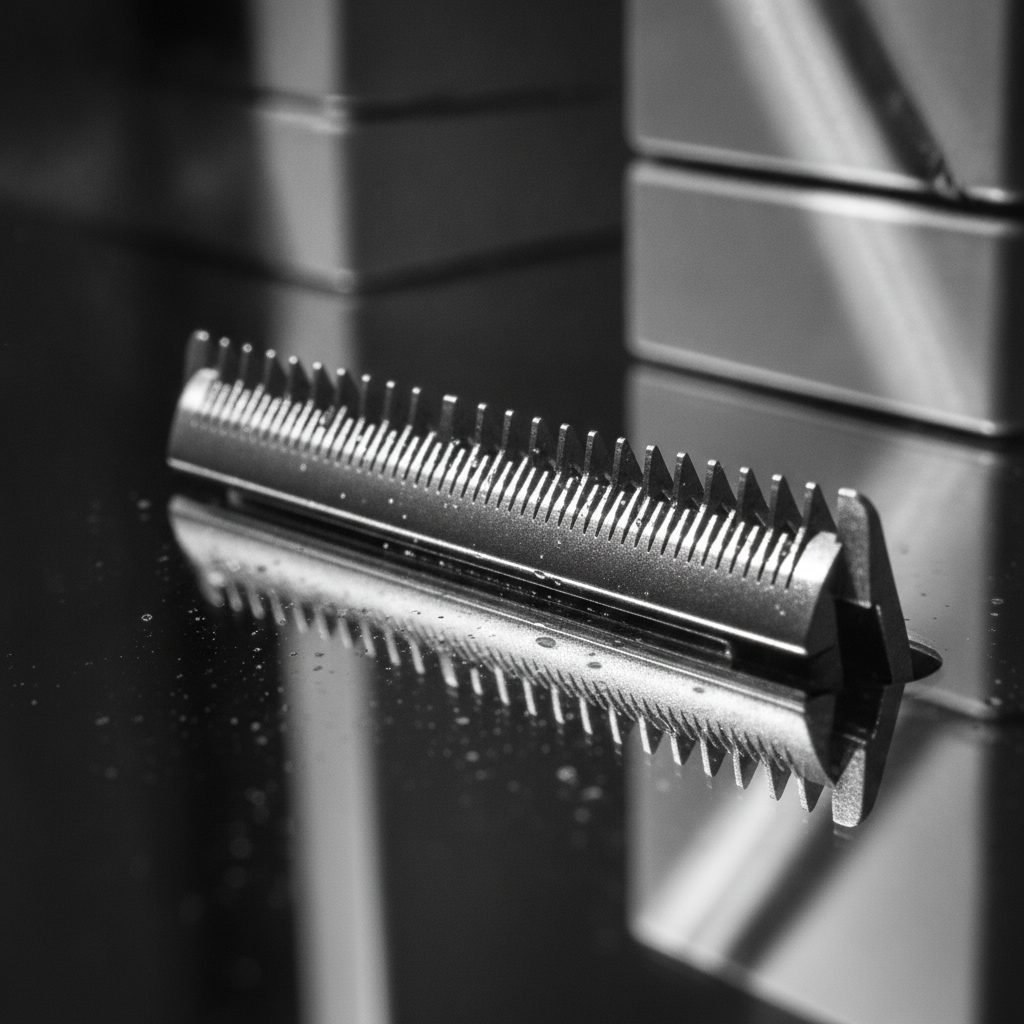
Clippers vs Trimmers — The Distinction That Matters
Hair clippers and beard trimmers are not the same tool with a different name. The differences are structural and intentional. A hair clipper blade spans 30–45mm wide to cover large sections of scalp in a single pass. A beard trimmer blade runs 20–32mm — narrow enough to follow a jawline and navigate the curves of a cheek. That width difference alone dictates which tool you reach for, but it goes further than geometry.
Head hair is coarser, denser, and grows from a scalp that produces more sebum than facial skin. Clippers are built around motors powerful enough to pull through weeks of head hair growth without snagging. Their guard comb systems are calibrated in increments most men know by heart: #1 (3mm), #2 (6mm), #3 (10mm), all the way to #8 (25mm). Beard trimmers operate in sub-millimetre territory — 0.5mm steps for precision, not bulk removal.
The economic case for owning a quality clipper is simple. A standard barbershop cut in London or New York runs £25–£45. At two cuts a month, that is £600–£1,080 per year. A £70 professional-grade clipper pays for itself in six weeks. The cut quality argument used to favor the barber; with the clippers now available to consumers, that gap has closed considerably.
What to Look For in a Hair Clipper
Blade Material
Carbon steel blades are the sharpest out of the box and hold an edge well in professional, high-frequency use. They corrode if left wet or un-oiled, which is why most professional clippers ship with blade oil. Stainless steel blades resist corrosion and require less maintenance but are marginally less sharp initially — though the difference is imperceptible to most users. Titanium-coated blades sit at the consumer end of the market: the coating extends blade life and adds rust resistance, making them ideal for men who want to use a clipper in the shower or are likely to skip oiling sessions.
Motor Type
Rotary motors are the most powerful and found in heavy-duty professional clippers. They run quietly, handle thick coarse hair effortlessly, and last for years of daily use. Pivot motors are the standard in mid-range consumer clippers — more torque than magnetic types, adequate for weekly home cuts, slightly heavier vibration. Magnetic motors are the lightest and fastest in strokes per minute, making them excellent for detail work and fade blending, but they can struggle in very dense, long hair if the blade gap is set too close.
Corded vs Cordless
Corded clippers deliver constant, uninterrupted power regardless of how long you run them. For thick hair or anyone who cuts multiple family members in a single session, corded is the pragmatic choice. Cordless clippers have improved dramatically — 60–100 minutes of runtime is now standard in the mid-range — but a depleted battery mid-cut is genuinely frustrating. Most premium cordless clippers now offer corded-and-cordless operation as a fail-safe, which is the configuration worth prioritizing.
Guard Combs
Plastic guards are standard and work well. Metal guards — offered by Andis and a few premium brands — clip on with greater precision and are less likely to flex under pressure, which matters when you are doing a tight fade and need consistent blade-to-scalp distance. The number of guards included varies from 4 to 17; for home use, 8 guards covering #1 through #8 is sufficient. Third-party compatibility is worth checking: Wahl and Andis both have extensive aftermarket guard ecosystems, useful if you want half-size guards for more granular blending.
Top 5 Hair Clippers for Men 2026
01Best Overall
Wahl Professional 5 Star Magic Clip Cordless
$140
The Magic Clip is the consensus pick for fades, and the cord/cordless version is the one to own. Its stagger-tooth blade is cut specifically for blending: the staggered teeth take hair in at slightly different lengths, which softens the line between guard lengths instead of leaving hard steps — the whole secret of a smooth fade.
It runs cordless for more than 100 minutes per charge — a full family Saturday of haircuts — and plugs in whenever you need it, so a flat battery never stops a cut halfway. It sits in Wahl's Professional 5 Star line, the series barbershops have stocked for years. Premium money, but you buy it once.
Spec
Detail
Blade
Stagger-tooth fade blade
Power
Cord / cordless
Runtime
100+ min cordless
Series
Wahl Professional 5 Star
Verdict
The Magic Clip is the standard other home clippers get measured against. If you want barbershop fades at home and only want to buy one clipper, this is it.
Andis built the Phenom around a brushless motor — less wear, less heat and less maintenance over the life of the tool — driving an adjustable, detachable Phaze Blade you can set and swap for different cutting lengths and styles. At 7,000 strokes per minute it is tuned for control rather than raw speed, which is exactly what you want when you are working crisp lines and detail.
The lithium-ion battery runs up to 2.5 hours per charge, it charges over USB-C, and it ships with a premium charging stand. The gold and black housings and grips are fully interchangeable, so you can set it up exactly how you like it, and it works corded or cordless.
Spec
Detail
Blade
Adjustable, detachable Phaze Blade
Motor
Brushless, 7,000 SPM
Runtime
Up to 2.5 hr cordless
Charging
USB-C + charging stand
Verdict
The premium Andis for men who value precision and longevity: brushless internals, a swappable blade and serious runtime, in a clipper that feels built to last.
The Color Pro's standout feature is also its most underrated one: color-coded guide combs, with a matching color key printed right on the face of the clipper. Snap on the color you used last time and you get the same length again — no squinting at tiny numbers, no guesswork halfway through a cut.
It runs cordless for 60 minutes and keeps working while plugged in to charge, the blades pop off and rinse clean under the tap, and worldwide voltage makes it a genuine travel clipper. The motor is consumer-grade rather than barbershop-grade — but for straightforward home cuts, it is all most men need.
Spec
Detail
Guards
Color-coded, with on-body color key
Power
Cord / cordless
Runtime
60 min
Blades
Removable, rinsable
Verdict
If you have never cut your own hair and want a low-stakes entry point, this is it. The color-coded system removes the single most common home-haircut mistake: the wrong guard.
The BaBylissPRO GOLDFX+ is a professional clipper in every sense: an all-metal body, a DLC/titanium gold taper blade, and an upgraded N1 brushless motor running on dual ball bearings for efficiency. It is built for the long, detailed passes a high fade or skin fade demands.
The 5-detent taper arm clicks through blade positions for controlled blending, the knurled barbell grip keeps it steady, and the lithium battery delivers up to 3 hours of runtime — the longest on this list — with USB-C charging. It works corded or cordless.
Spec
Detail
Blade
DLC/titanium gold taper blade
Motor
N1 brushless, dual ball bearings
Runtime
Up to 3 hr cordless
Build
All-metal, knurled barbell grip
Verdict
The pick for men whose priority is a clean high fade or skin fade at home — and who want a clipper built like it belongs in a barbershop.
Remington built this kit specifically for the home fade, and at around $35 it is the least expensive way on this list to get one right. The blades are Japanese-grade steel with a titanium coating for lasting sharpness, and the kit pairs five colored tapered fade combs — from 1.5–3mm up to 12–16mm — with nine standard fixed combs.
A taper lever smooths the transitions, a non-slip grip keeps control, and a blade guard protects the edge in storage. The cleaning brush, oil and a storage case are all in the box, and it is backed by a 5-year limited warranty.
Spec
Detail
Blades
Japanese-grade steel, titanium-coated
Fade combs
5 tapered (1.5–16mm) + 9 standard
Extras
Taper lever, oil, brush, case
Warranty
5-year limited
Verdict
The right choice for a first attempt at fading your own hair: low cost, the right combs for the job, and a warranty that outlasts most budget clippers.
The confusion between these two tools persists because they look similar and both cut hair. They are not interchangeable. Using a beard trimmer on your head means multiple slow passes through terrain the tool was never engineered to cover efficiently. Using a hair clipper on your face risks pulling at shorter, finer facial hair with a blade designed for coarser material. The table below makes the specifications clear.
Feature
Hair Clippers
Beard Trimmers
Blade width
30–45mm
20–32mm
Motor power
High (head hair is coarser)
Lower
Guard range
3–25mm (#1–#8)
0.5–20mm
Precision
Bulk cutting focus
Detail + precision focus
Best for
Head hair, body hair
Facial hair, necklines
Blade Gap, Zero Gap and Fades Explained
What Is Blade Gap?
A clipper blade is made of two components: the stationary bottom blade and the moving top blade. Blade gap refers to the distance between the tips of these two blades when the clipper is running. A wider gap produces a slightly longer cut even without a guard — the hair must enter the gap further before the moving blade reaches it. A narrower gap cuts closer because the blade teeth intercept the hair sooner.
What Does Zero Gap Mean?
Zero gap describes the position where the teeth of the moving blade are aligned flush with — or very slightly overlapping — the teeth of the stationary blade. In this position the clipper cuts as close to the skin as physically possible without a guard. This is the configuration used for skin fades, edge-ups, and temple cleanups. It is also the setting that can cut the skin if used carelessly, which is why zero-gap work is done with light, confident passes rather than slow grinding pressure.
What Does the Taper Lever Do?
The taper lever — the sliding switch on the side of professional clippers — adjusts the blade gap continuously between open (maximum gap, longer cut) and closed (minimum gap, skin-close cut). Its value is in blending: rather than switching between two different guard lengths to blend a transition, you can hold the same guard and gradually open or close the lever as you work up through the fade. This is how professional barbers blend invisibly — constant micro-adjustments via the lever, not guard swaps.
How to Do a Simple DIY Fade at Home
A simple graduation from a #4 on top down to a #1 near the temples can be achieved with four guard combs and a methodical approach. Begin with a #4 guard covering the entire sides and back up to the natural recession line. Switch to a #3 and work from just below the #4 line upward, blending into the bottom of the #4 zone with scooping, flicking motions — never dragging straight across the blend line. Repeat with a #2, blending into the bottom of the #3 zone. Finish with a #1 close to the skin at the sides and nape, blending gently into the #2 line above it.
At each transition zone, the taper lever is your tool. Close the lever slightly as you approach the lower zone; open it as you move into the upper zone. The result is a graduation that reads as a continuous gradual change rather than a visible step between lengths. Work in a well-lit space with two mirrors and take time at each transition rather than rushing. A patient first pass almost always looks better than an aggressive one.
Blade Maintenance
A sharp clipper blade dulls not from cutting hair but from running dry. The friction between the moving and stationary blade generates heat and accelerates wear when there is no lubricating film between them. Oil every three uses at minimum — more often if you are cutting multiple heads in one session. Place two drops of clipper oil along the top of the blade teeth while the clipper is running, so the oil distributes itself across the full blade width by capillary action and blade movement. Wipe away excess oil before cutting to prevent transfer to the hair.
After each use, brush hair debris from between the blade teeth using the cleaning brush that ships with the clipper. Hair packed between the blades prevents them from seating properly against each other, which introduces drag and uneven cutting. For clippers without waterproofing, never rinse the blade under water — use the brush and a dry wipe only. For waterproof models, rinsing the blade under running water is the most effective method of cleaning, followed by thorough drying and oiling before storage.
Blade alignment is worth checking periodically, particularly after the clipper has been dropped. The stationary blade should protrude no further than the bottom of the moving blade's tips — if the stationary blade protrudes further, the exposed lower teeth can scratch the scalp. Most manufacturers provide a blade alignment procedure in the manual; it typically involves loosening the blade screws, aligning by eye and feel, then re-tightening. If you are unsure, your local barbershop will often align a blade for a nominal fee or at no charge.