A good beard trim comes down to two lines and one rule. The lines are the neckline and the cheek line. The rule is to take off less than you think. Get those right and a $60 trimmer at home will keep your beard looking barber-kept between visits. Here is the whole process, step by step, with the tools we would use.
| 01 | 01Philips Norelco Beard Trimmer 5000The trimmer | Shop → |
| 02 | 02Wahl Stainless Steel Lithium Ion 2.0+ Beard TrimmerAll-in-one alternative | Shop → |
| 03 | 03Aberlite ClearShaper 3.0 Beard ShaperLine guide (optional) | Shop → |
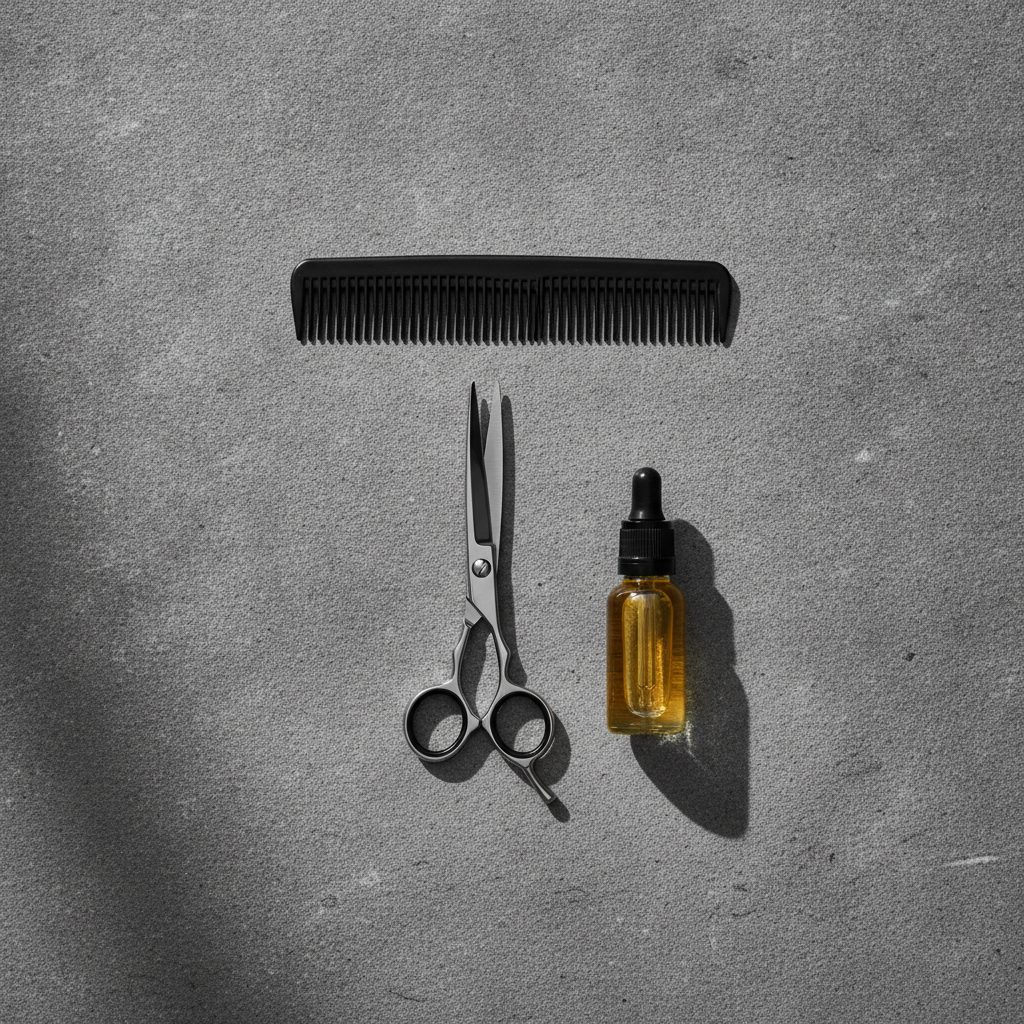
| 04 | 04Ontaki 5" Beard & Mustache Scissors with CombsMustache and strays | Shop → |
| 05 | 05Kent R7T Fine & Wide Tooth CombCombing out | Shop → |
| 06 | 06Honest Amish Beard Oil, Fragrance Free (2 oz)After the trim | Shop → |
Before You Start: Wash, Dry, Comb
Trim a clean beard, and make sure it is completely dry. Wet hair hangs longer and straighter than dry hair, so a beard trimmed wet usually ends up shorter than you planned once it dries and springs back.
Comb everything out in the direction it grows so each hair sits at its real length. A saw-cut comb like the Kent R7T glides through without snagging. It has fine teeth on one side and wide teeth on the other, it is 5.1 inches long and made in England, and it costs about $9 (sold by The Bayside Brush Co.).
Step 1 — Pick a Length, and Start Longer
Choose the guard or dial setting you think you want, then go one or two settings longer for your first pass. You can always take more off. You cannot put it back.
A dial trimmer makes this easy. The Philips Norelco Beard Trimmer 5000 has 40 length settings in 0.2 mm steps, so you can step a beard down gradually instead of jumping a whole guard size. It comes with a charging stand, beard fading combs and a detail trimmer.
If you would rather have one tool for your beard, nose and a close shave, the Wahl Stainless Steel Lithium Ion 2.0+ is the all-in-one alternative at about $81. It comes with four heads (T-blade, precision detailer, rotary nose and ear trimmer, foil shaver), eight T-blade guide combs from 1/16" to 1/2" plus two adjustable combs. Wahl rates it at 3.5 hours of runtime per charge.
Step 2 — Take Down the Bulk
Work in sections: one cheek, the same cheek on the other side, then the jaw, then the chin. Doing matching areas back to back makes it far easier to keep the two sides even.
Trimming against the direction of growth gives the most uniform length. Trimming with the grain takes off a little less and leaves a softer finish. On the neck, hair often grows in swirls, so go over it from a few directions.
Stop every minute or so, comb the beard out again and look at it straight on in the mirror. Most uneven trims happen when you keep going on one side without checking the other.
Step 3 — Set the Neckline
This is the single biggest upgrade most beards can get. A common barber rule of thumb puts the neckline about one to two finger-widths above your Adam's apple.
Picture a gentle U-shaped curve running from just behind each ear down to that point. Everything above it stays; everything below it gets trimmed down to skin or shaved.
Set it too high and the beard looks small from the side. Set it too low and the beard looks unkempt even when the rest is neat. If you are unsure, start low and move up a little at a time.
If you struggle to keep the line straight, a clear template helps. The Aberlite ClearShaper 3.0 is a transparent plastic guide with several edges and angles; it comes with two white barber pencils so you can draw the line first and then trim to it. It costs about $20 (sold by Aberlite).
Step 4 — Tidy the Cheek Line
If your cheek line is already fairly clean, leave it natural and just remove the strays above it. Most beards look best when the line follows where the hair grows.
For a sharper look, imagine a line from the top of your sideburn to the corner of your mustache, straight or slightly curved, and remove only the hair above it.
Be careful not to push the cheek line too low. It is the most common way a home trim goes wrong, and it takes weeks to grow back.
Step 5 — Mustache and Stray Hairs
Comb the mustache straight down and trim along the top of your lip with small scissors, a few hairs at a time. Scissors also catch the odd long hair a trimmer misses on the cheeks and chin.
The Ontaki 5" beard and mustache scissors are made of high-carbon German steel, according to Ontaki. They come with a mustache comb, a beard comb and a PU leather pouch, for about $15 (sold by Ontaki USA).
Step 6 — Fade the Sides (Optional)
If your beard is fuller than your sideburns, trim the sideburns and upper cheeks one or two settings shorter than the chin. The beard then blends into your haircut instead of ending in a hard step. The fading combs on the Norelco 5000 are designed for this.
After the Trim: Oil and Clean-Up
Rinse off the loose hair, then work a few drops of beard oil through the beard and onto the skin underneath. A fragrance-free oil won't clash with your cologne.
Honest Amish Beard Oil, Fragrance Free costs about $12 for 2 oz (sold by Honest Amish), and the brand says it is hand-crafted in the USA.
Brush the hair out of the trimmer head and follow the manual for cleaning and oiling the blades.
How Often to Trim
As a starting point, clean up the neckline and cheek line every few days to a week, and do a full trim every two to four weeks. Adjust to how fast your beard grows and how sharp you like it.
Common Mistakes
- Trimming wet. The beard shrinks as it dries, and you end up shorter than planned.
- Starting at your target length. Start longer, then step down.
- A neckline on the jaw. It should sit below the jaw, roughly one to two finger-widths above the Adam's apple.
- A cheek line pushed too low. Remove strays first, and only lower the line if you are sure.
- Chasing symmetry. Stop, comb out and check both sides before taking more off.
FAQ
Should I trim my beard wet or dry?
Dry. Wet hair hangs longer and straighter, so a beard trimmed wet ends up shorter than you intended once it dries.
Where should my beard neckline be?
A common barber rule of thumb is about one to two finger-widths above the Adam's apple, following a U-shaped curve back to just behind each ear.
What trimmer length should I start with?
Start one or two settings longer than your target, trim everything evenly, then step down one setting at a time until it looks right.
Can I trim my beard with scissors only?
Yes, especially a long beard, but it is harder to get an even length. Most men use a trimmer for the bulk and scissors for the mustache and stray hairs.
Choosing a trimmer? See our best beard trimmers guide, and our best beard oil guide for what to use afterward.